Tag: Looper

Soma COSMOS

The legendary tape-loop experimental art setup pioneered by Brian Eno and Robert Fripp, later labelled “Frippatronics” has long held fascination for me. Tape loop overdubs that interfere, decay and randomly reassign have the potential as a musical system to elevate play into really different places.

I saw a post on HAINBACH’s youtube channel comparing and contrasting “loopers”, I was instantly fascinated by a relatively recent instrument out of Soma Labs in Poland – the Soma COSMOS. Labelled as a “Drifting Memory Station”, it is a modern re-creation of a tapeloop setup that has a huge number of variations, or algorithms, that have the job of repeating and distributing incoming audio across a number of tracks in various places in the stereo field. I knew I had to have one. Finding a distributer and subsequent back-ordering has taken an age but I now own a unit and wasted no time exploring it.
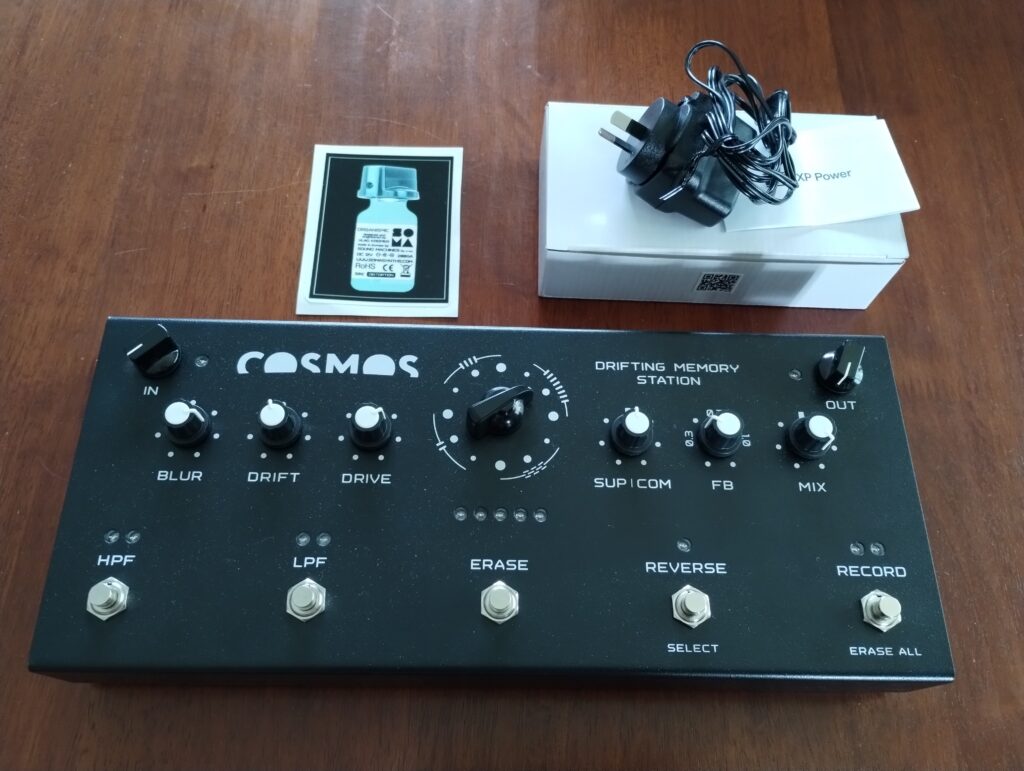
Initially, I patched in my Stylophone Gen X2 into the input, and began noodling to see what the various algorithms do. There is a 2 and 4 channel tape loop simulation, with loop lengths varying from 2.5, 9.5 or 22 seconds, a huge reverb chamber algorithm and an asynchronous granular delay algorithm – all 4 do really different things with the incoming signal.

My first recording used the stylophone, giant reverb and you can watch a recording of me performing it here:

The sound on the YouTube post-processing is a little grainy (and not true to the recording), the Soundcloud recording is as it was recorded during the session:

By noodling, I found the best results came from restraint – the loops get dense really quickly unless you throttle the feedback. “Drift” settings control how the input and subsequent repeats are distributed in the stereo field and “Blur” controls how quickly the signals melt into each other. It seems to prefer MONO input as it then creates the stereo picture as the sounds evolve – all very interesting.

Additionally, apparently i can download NEW firmware that reassigns the Cosmos into a percussion station and a conventional looper, so there is LOADS more to explore in this instrument. I have barely scratched the surface of its capabilities.

(more…)
LV-426 Autumn

The Theremin is different to conventional instruments in that making precise musical notes is one of many challenges you face when playing it. I am a reluctant practiser – I would much rather skip the whole skills acquisition phase and jump straight to the part where I am awesome at it… but that is not how life works sadly.

I have been reluctant to post recordings of my playing because I do not feel I am good enough at pitch control yet, but I decided to commit some time to ‘composing’ and recording an ambient spacescape that showcases the varied synthesiser voices that are available on the Theremini.

For the uninitiated, a Theremini differs from a classic Theremin in that it is a DIGITAL re-work of the original interface – the whole antennae thing on the original is ANALOG – the resulting analog distance from the antenna creates a smooth glissando, and generally only plays one type of noise (or voice), with variations in tone and waveform. A Theremini on the other hand is a full synthesiser (you can create totally new sounds) but uses the antennae to control pitch and volume/effect in a similar way to it’s analog ancestor. The distance from the antennae is sampled digitally, so the glissando can be much more granular.

For this piece, I wanted to get better at using my Ditto+ looping pedal – a foot-driven mono guitar pedal that lets me record and overdub over recordings live. I have been working my way through the Alien movies, and the ambient soundscape interests me greatly – it is a mood setter, so I decided to have a go at making one.

I selected the “lost in fog” preset on my Theremini, and dialed the preset effect back to about 1/4 strength (it is a stereo drift effect, lost on mono capture anyways) and tuned it to Phrygian mode (a “dark” scale). I played with the almost sub-sonic sound until I got a progression I liked and then recorded using it for about a minute, fading volume in, up and down then out at the end.

Next I chose the “Futurewarz” voice (think opening credits to the original Bladerunner movie), also tuned to Phrygian mode, and bumped the effect (a spatial delay) up to about half. This voice is really loud and harsh, so precise volume and pitch control was the aim – a restrained and minimal solo track was laid over the bass hum after much experimentation and pitch-control practise. I did NO post-processing or mixing here. The sound you hear is how it was made on the Theremin.

The result is about a minute of the sort of sound that (to me) resembles Bladerunner on LV-426 (the planet we originally met the Xenomorph in the first and best Alien movie).

Enjoy, tolerate, ignore – your choice:

Gear

So I have begun to think about the actual playing of this instrument.

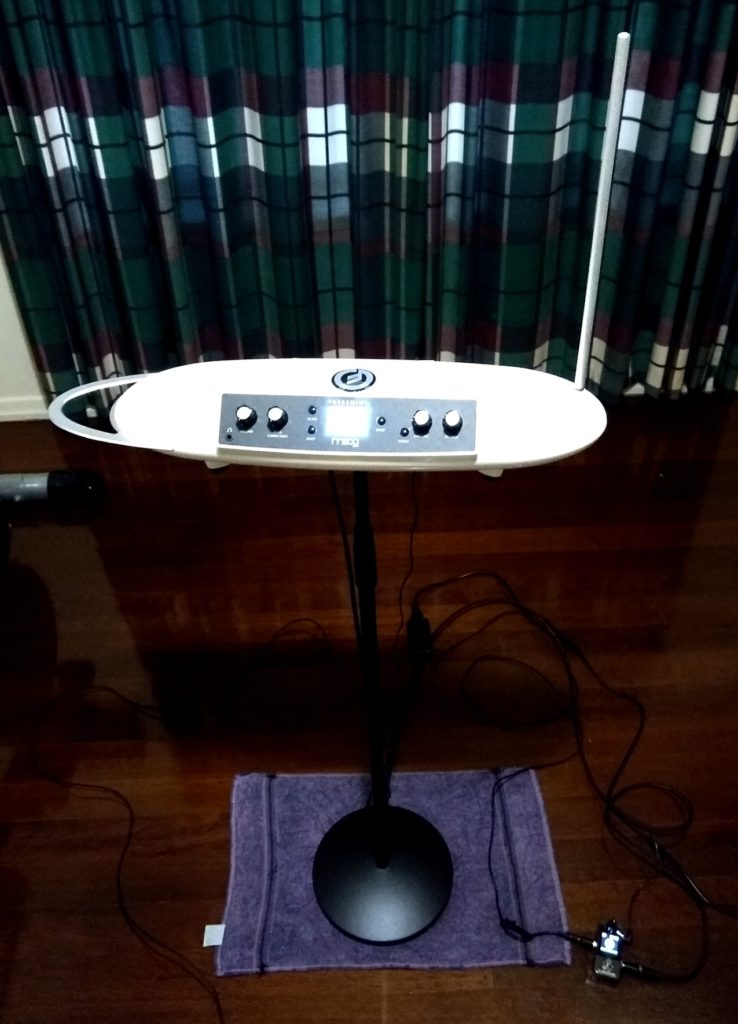
Sitting at a table, with it on that table places the antennae too high, making the angles for attenuation uncomfortable and inaccurate, so I decided to buy a microphone stand to support it. On the underneath of the chassis there is a 3/8″ mike stand screw socket (female) designed just for this purpose.

I returned to Manny’s and purchased a Konig-Meyer heavy round-based black stand – the manufacturers website said it had the correct thread size head, but the ones in-store had 5/8″ screw head. I had to buy a converter (even after being assured by the salesman that it was 3/8″, until he actually looked – a bit annoying given the multiple contacts to determine this).

Theremini on Konig-Meyer stand, with DITTO+ Looper

The height is now comfortable – a side effect is that my pitch control is MUCH more controlled when standing, and when using a slightly split stance, the approach to both pitch and volume antennae work much better.

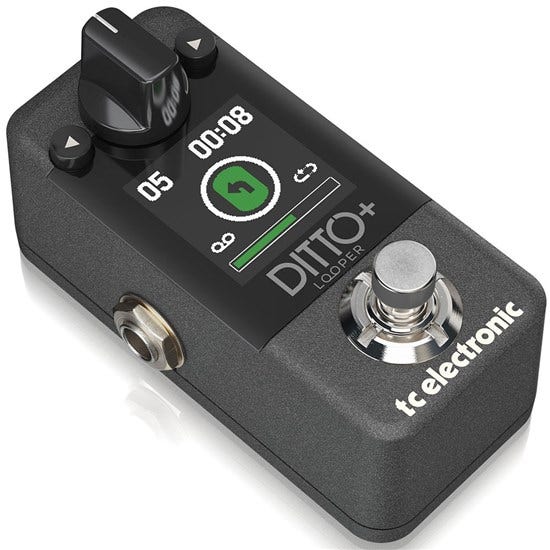
I began researching LOOPER pedals (like those guitarists use so they can self-accompany), decided on a DITTO+Looper, returned to Manny’s and purchased it, along with a compatible power supply (it seems guitar pedals do not routinely ship with them), and cable to connect it to the Theremini, and a converter to allow me to plug my headphones into the pedal OUT so I can hear the results.

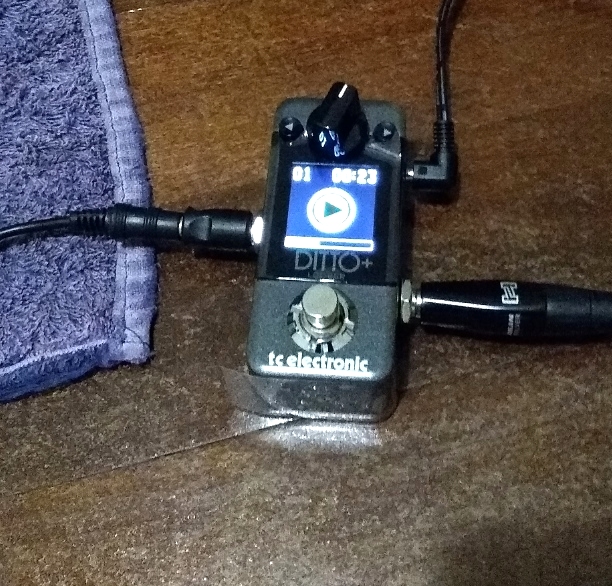
Ditto+ Looper pedal

In a brief hiatus from marking, I hooked it all up to test it out. The Pedal IN and therefore Theremini OUT needs to be MONO (interestingly, the Theremini has a stereo output – most of it’s presets are “spacial” sounding, but plugging the looper into either the L or R channel makes it output balanced MONO to the pedal. I did not realise guitars output MONO – you live and learn.

DITTO+ Looper pedal

The pedal has nearly no controls – it’s simplicity is legendary. I managed to record a loop using one instrument, then overdub with another, then play live over the top of all this – this is HUGELY exciting, particularly when I get a chance to actually get musical. The looper uses solid-state storage also, so I will keep loops I like. Conventional pedals lose everything when powered down apparently, so this should be fun.

Lots to look forward to playing with.