The legendary tape-loop experimental art setup pioneered by Brian Eno and Robert Fripp, later labelled “Frippatronics” has long held fascination for me. Tape loop overdubs that interfere, decay and randomly reassign have the potential as a musical system to elevate play into really different places.
I saw a post on HAINBACH’s youtube channel comparing and contrasting “loopers”, I was instantly fascinated by a relatively recent instrument out of Soma Labs in Poland – the Soma COSMOS. Labelled as a “Drifting Memory Station”, it is a modern re-creation of a tapeloop setup that has a huge number of variations, or algorithms, that have the job of repeating and distributing incoming audio across a number of tracks in various places in the stereo field. I knew I had to have one. Finding a distributer and subsequent back-ordering has taken an age but I now own a unit and wasted no time exploring it.
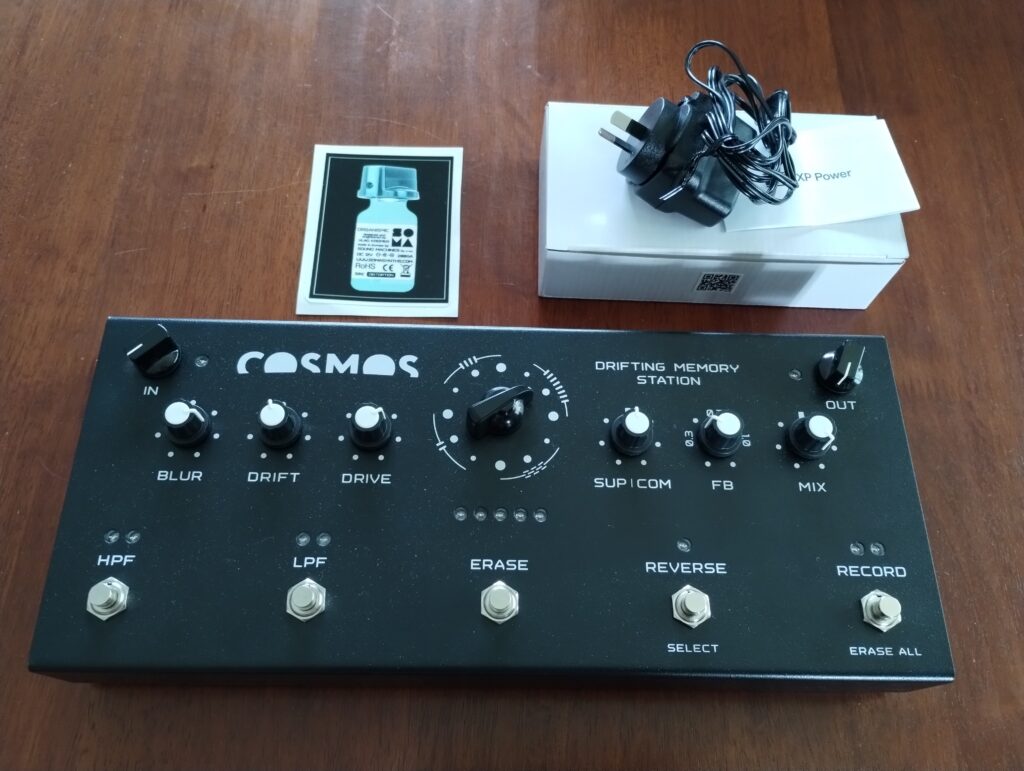
Initially, I patched in my Stylophone Gen X2 into the input, and began noodling to see what the various algorithms do. There is a 2 and 4 channel tape loop simulation, with loop lengths varying from 2.5, 9.5 or 22 seconds, a huge reverb chamber algorithm and an asynchronous granular delay algorithm – all 4 do really different things with the incoming signal.
My first recording used the stylophone, giant reverb and you can watch a recording of me performing it here:
The sound on the YouTube post-processing is a little grainy (and not true to the recording), the Soundcloud recording is as it was recorded during the session:
By noodling, I found the best results came from restraint – the loops get dense really quickly unless you throttle the feedback. “Drift” settings control how the input and subsequent repeats are distributed in the stereo field and “Blur” controls how quickly the signals melt into each other. It seems to prefer MONO input as it then creates the stereo picture as the sounds evolve – all very interesting.
Additionally, apparently i can download NEW firmware that reassigns the Cosmos into a percussion station and a conventional looper, so there is LOADS more to explore in this instrument. I have barely scratched the surface of its capabilities.
Claravox Theremin Experiments
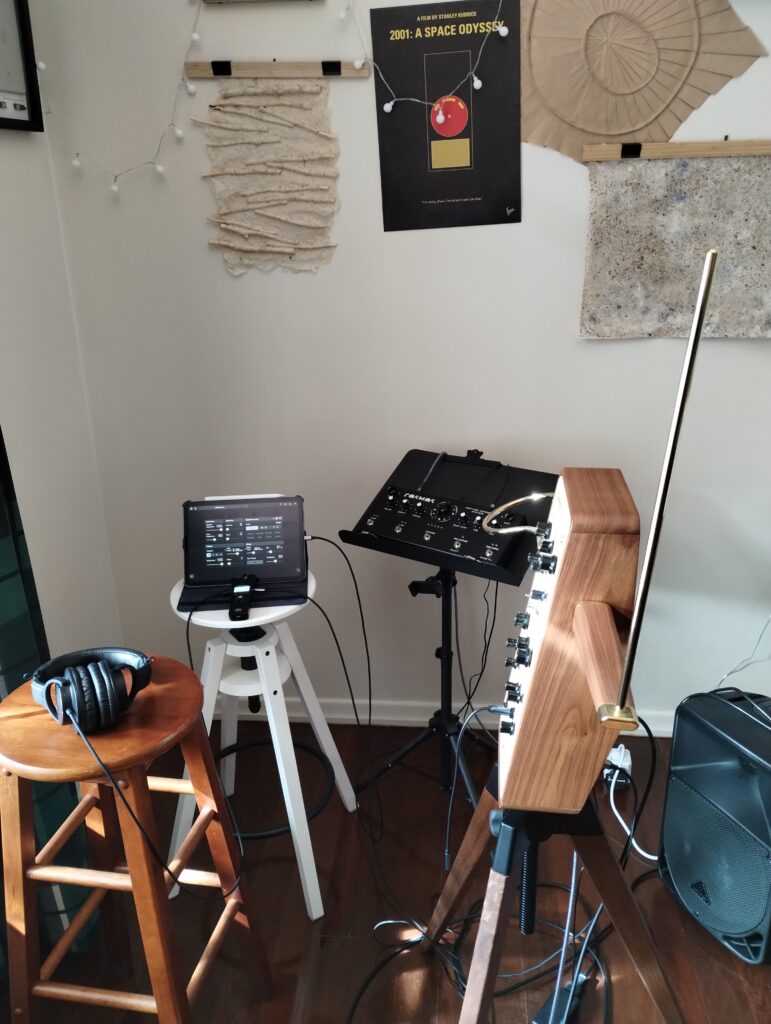
Naturally I was keen to hook it up to my Moog Claravox Theremin. I love the rich smoooooth sounds that emanate from this instrument, and my comfort playing it has increased no end. My pitch accuracy is assisted by a Pitch pedal, and sitting while playing is helping with my consistency of pitch. For this piece however I was interested in pitch dynamics, and after a small amount of parameter twiddling I was able to capture a performance that I am pleased with:
Moog Theremini Experiments
Continuing my experimentation, I dug out my Moog Theremini which I must admit I rarely play because … Claravox … but remembered the plethora of interesting voices available via the Moog Theremini Editor software so thought it worth firing up and hooking into the loop rig.
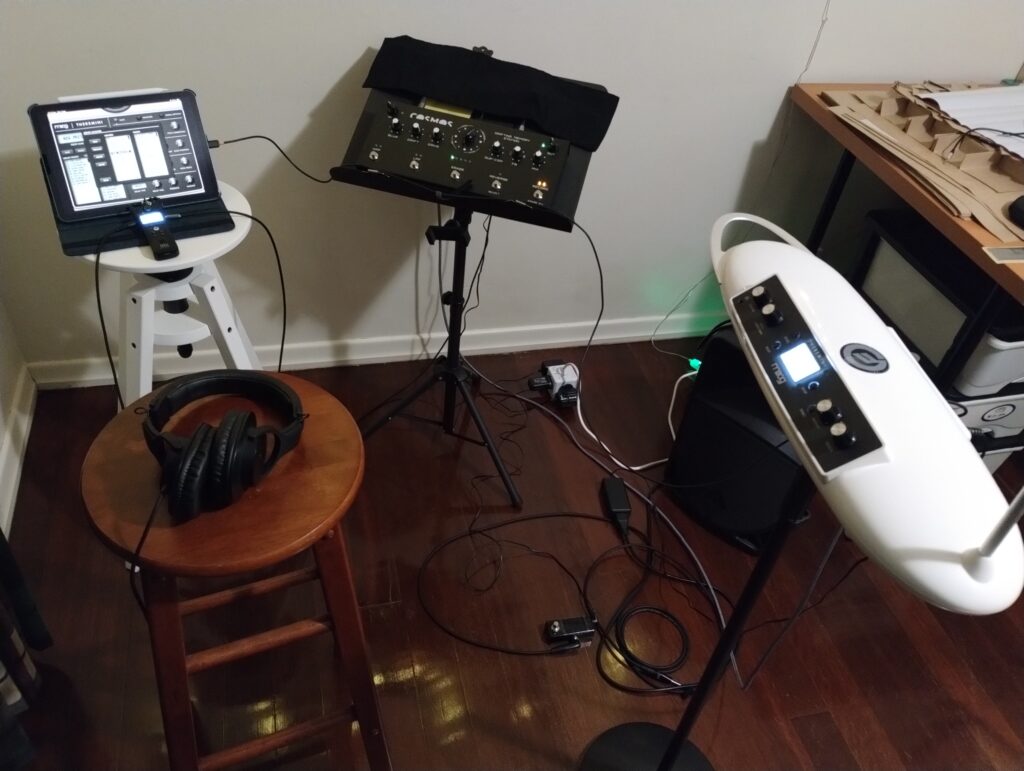
After calibration I started looking for loopable voices and exploring recording levels. The Theremini has a very HOT output signal, necessitating dialing back the input volume into the looper to prevent overload and clipping. I did not notice such issues on the Claravox, but they are different instruments I guess.
One evening, after a couple of glasses of wine, I dimmed the lights, fired up the rig, and recorded 5 different pieces, in succession, all using different Theremini voices. Each piece was preceded with a noodle to get used to the performance characteristics of that voice. It is possible, you see, to change how the instrument behaves when interacting with the pitch and volume antennae. You can create envelope shaping and velocity effects on top of the conventional antennae functions and this greatly changes how you perform using that voice. I am still exploring the power of the editors for both Theremins as the sound variety and playing timbre seems infinitely controllable.
Anyways, what follows is the sequence of compositions, in the order they were recorded. As with ALL of my theremin recordings, there is NO post-production, no EXTERNAL effects, all the sound you hear is as performed within the capabilities of the rig I am using (Theremini, Cosmos Looper into my Zoom H1n Stereo recorder). All I have done on each piece is fade in and out at the top/tail for clean entry/exit of the piece. Because I can trim and control the audio characteristics and “effects” live while actually performing, that is what I prefer to do rather than push it through effects chains after the performance.
It pleases me no end that, although the rig is the same each time, the mood and musical intent is really different. It is also interesting that the “digital” Theremini voices have a huge variety in granularity, timbre and response, which in interacting with the various looper algorithms, create intricate and dense soundscapes.
It was late, I was tired, so left review/culling until I was fresh the morning after. It surprised me that these 5 (of the 7 recorded) still felt interesting to me after a good night sleep.
More exploration to come.
Leave a Reply