
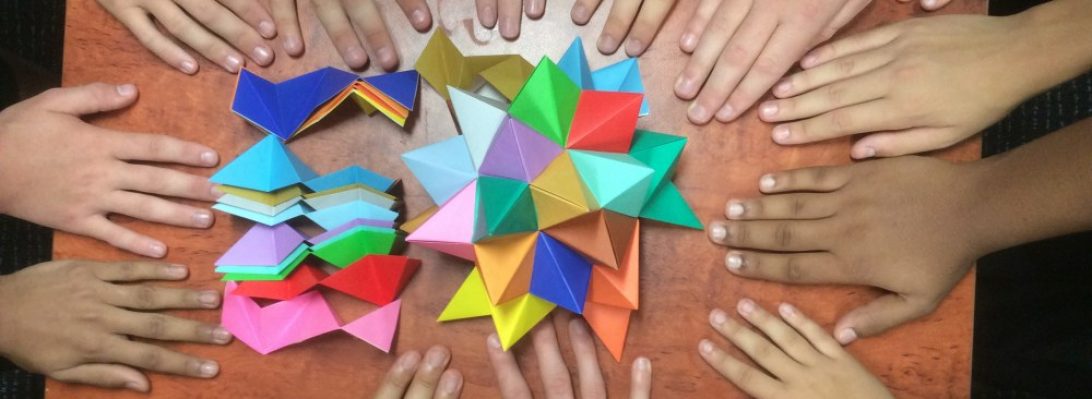
I have been playing with approximations of non-euclidean based geometric representations of “squares” – those shapes that have 90 degree corners. In curved space that geometry gets seriously weird, really quickly.

I operated on some standard Kami to create shapes that had 90 degree corners, but to my surprise, I managed a 2,3,5,6 and 8-sided “square”, depending on the size of the “plug” I grafted into the square.
I could then form “square bases” with these sheets – the preliminary fold is the base for many designs. Interestingly, the number of points a sheet has when put into a preliminary base is governed by the number of sides the sheet has.

Working on the 8-sided square, I then went about folding a traditional crane (Tsuru), and noticed I ended up with a surplus of appendages. With some re-arrangement I was able to return some of the classic vibe to the rear of the crane, but that resulted in 5 heads.

I have seen similar (like up to 3 I think) multi-headed cranes designed from conventional 4-sided squares, but the model efficiency is usually terrible because the point-splitting methods necessarily reduce the size of the final model exponentially.
Continue reading