Ages ago, using up the white papers from a cheapo pack of coloured 15cm square origami papers, I first had a go at folding an origami “Spirit House”:
Designed by Ichiro Kinoshita, this model emerged from my “to fold” pile and it was meant to be.
I had not long returned from a trip to Japan (in the late nineties), and fell in love with the idea of having a Spirit House at our front door. Apparently it is a tradition to provide a home for good spirits – they then repel bad spirits. We have had our “spirit house” for decades, I love it.
I decided it was time to fold a better version of the rough first go, so turned to my stash of hand-made Kozo and cotton paper I had made from pulp back in October 2024 – it has a “stone-like” appearance so I thought it would be perfect.
I cut 3 18x18cm squares and a 20cm square, then set about folding the parts (it is sort of a modular, 2 parts of which need to be glued together). The paper is fairly thick and fabric-like, but takes folds fairly well. I used some strategic glue spots to keep seams closed, wrestled a little with the thickness but was happy with the results in the end.
As often happens, I was approached by a mate to fold a model for him (MJ) – he wanted a “Chook” for a surprise gift for his wife (Nikki) on her birthday. I love a challenge, so began looking for the best origami chook.
Turns out there are LOTS of roosters out there, but relatively few hens that looks like hens – I wanted feathers, volume and a playful but realistic chookiness and found in Makoto Yamaguchi’s beautiful book “Transcendent Origami”, a chicken designed by Kyohei Katsuta that I knew I needed to fold because it was perfect.
After doing a test fold, it became apparent that it was a 2-part model (top half has the rings and tail, comb and wattle) and the bottom half has the legs, beak and fluffy bum. It is a colour change model so with some careful “Kimiroing” I was able to use 2 sheets of glorious black spattered Shadow Thai (from origami-shop.com) that has Rorschach-like inkblots on one side, black mulberry on the back. The black was perfect for feet and beak. I laminated some red Kozo in the spot that would become the comb and wattle and I was away.
From my test fold, I was able to guestimate the paper size to make the chook more or less life-size – well, more of a bantam, but large enough for my purposes.
One of the many models I have had on my “to fold” pile for ages is Chen Xiao’s “Walking in the Rain”:
This box-pleated model seems to have taken me an age to complete for many reasons (including what I consider a weakness of box pleating), but finally I committed a square of pre-prepared Wenzhou paper to a rendering of this design.
The paper was previously Eco Dyed: Sandwiched between each layer of the folded up sheet was various vegetative matter – onion skins, tea leaves and other tannin-based plants. This bundle was boiled for a few hours in a “dirty pot” containing red cabbage and purple carrots. The cooled bundle was then carefully washed to remove all the bits of vegetation leaving subtle stains. This paper I called “Cherry Blossom” Wenzhou because the dappled pinks and muted browns reminded me of blossom trees.
One of the privileges of being on the edit team for Origami Shop is that I get to see new designs before they are in the wild:
Part of the edit process, often, is test folding the model. I do not need to do this, usually, because there is also a team of test-folders, but I like to check the instructions and how they work – it can inform better diagrams.
I have a recent stash of hand made (from plant to sheet) Kozo tissue I was itching to try on a fold.
This Koi Carp, designed by Yery J. Astroña, will be part of a forthcoming book – it is a 182 step sequence, so I thought (rather naively) … why not?
I had no idea how the paper would take folds – there are 3 pages of pre-creasing before collapse, but I figure I would fold until I finish or it failed – either outcome I can learn from.
To my delight, my paper (a 28cm square liberated from an A3 deckle-edged sheet) was completely stable – no sign of fatigue at the end. It takes creases pretty well, reverses those creases nice and accurately. It is crisp, thiiiiin, and softer than Kami, but I found it completely foldable. It wet-shapes beautifully – very satisfying experience indeed.
Last PAQ meeting I had the privilege of running the group’s Hollander Beater, processing my most recently cooked and cleaned paper mulberry pulp. In the past I have hand-beaten it, but was determined to give the mechanised processing a try (to see if I could).
The pulp floofed up into delicious clouds of softly frayed pulp after a few hours circulating in the beater. I took the beaten pulp home, rinsed it a couple of times and then pressed it into pulp storage sheets. I ladled 3 x 2L scoops of pulp into my old A3 mould and deckle, smoothing it off with my hands, then added them to my press, couching between. The batch made 6 such sheets.
After pressing, these pulp sheets were set to dry over the next week – when dry they are storage stash stable.
For the tissue session, I re-hydrated one of these sheets in a tall bucket, tearing it up until it was finely shredded. I then agitated it with my electric drill and a paint-stirrer attachment until it was separate and fluffy again. I brought the bucket of pulp and most of my sheet forming equipment to the PAQ meeting last Sunday and set up a bit of a production line.
I have a large vat (so I can easily move my A3 frame in it), and half-filled it with water. Then added 2 scoops of pulp to the water in the vat, along with half a bottle (about 100ml) of pre-prepared Methyl Cellulose (MC) gel and about 200ml of strained Okra mucilage. The MC was to act as an internal size for the paper (to help with the strength and crispness). The Okra mucilage acted as a suspension aid to keep the pulp from quickly sinking to the bottom of the vat.
After a thorough mix to fluff up and evenly distribute the relatively sparce pulp in the water, I was able to pull sheets by catching the “clouds” that so delicately hung in the water.
I have been making Mulberry tissue, and wanted a non-trivial model to test the foldability of the untreated sheets. I remember finding @taniiiii_ori ‘s Fractal Crane CP on Twitter ages ago, so decided it was perfect – based on a traditional fold, with a modern complex twist:
I picked the first sheet of tissue I pulled from my vat of freshly beaten kozo pulp – it was imperfect, painfully thin but none the less lovely. I cut the largest square I could from the most solid end and then set to laying in pre-creases for an n=2 fractal.
The CP is easily extended to add new levels, but the folds get impossibly fiddly exponentially – an n=2 was a good compromise I thought.
I was delighted to find that the paper took the pre-creases well, with no visible fatigue as I exposed the sheet to torsion and tension making the fiddly folds in the central gutter. Once creases were in and oriented correctly (mountains or valleys depending on their job) , the collapse began. The small bird-bases collapse and that allows the central gutter to form naturally around them.
One of many issues with long-term storage/display is the nature of the material itself – paper.
Most origami paper is not acid-free, meaning that over time the colours change as oxidation and UV damage take their toll on what is essentially a fragile material. Moisture and humidity conspire to “unfold” folded paper, causing it to want to return to the flat state, unless wet-shaping has been used to change the “memory” of the sheet fiber orientation.
Many models are not self-standing, so stands or other tricks are necessary to allow them to present upright – I have used both plastic clip stands and more permanent wire armature bases.
For the presentation/display model of Sampreet Manna’s beautiful new Peacock, I have used a few techniques to stabilise it in readying it for display (September – December I typically have display cases of my work in Suburban libraries).
This model is top-heavy – although the legs are pretty life-size in terms of the body proportions, they are spindly and the claws are not wide-spread enough for the model to self-support. I took some heavy gauge anodised aluminium armature wire, covered it with paper offcut from the sheet I was working with (“Earth” Tapa Duong Vietnamese fiber paper from @oritube_master ‘s shop) using PVA glue. Covering the wire with paper first makes adherence to the main model much more securely.
Once the wire segments had dried I then buried them deep in the pleats that made up the legs, closing the layers as I did using PVA glue dabs and then clamping it all in place whit it dried. The result is now that the model is help up by the leg wires, allowing me to permanently pose the “knees and ankles” without compromising the model stability.
Additionally, adding small PVA glue dots inside seams stops them from opening back up and greatly contributes to the long-term stability of the pose. I do not think this is as “cheaty” as bathing the model in MC and wet-sculpting it, like many origamists do. I have employed wet hands while shaping as a more gentle (and authentic) wet-folding technique and indeed some of the nice organic smooth curves achieved on this model were done that way. By wetting the paper, positioning it and then letting it dry the more subtle shapes become permanent,
The base this time was a white plastic lid from an empty container that was being recycled. I covered it with hand-made Kozo/cotton/day lily blend paper I made a few years ago – a lovely contrast that was interesting but not too busy as to distract from the already visually striking paper the model is folded from. Selecting a suitable base – be it a round lid or a plinth made from foam core can greatly enhance the stability of the model and give it a “finished” look.
The wires are punched through the top of the lid, bent tightly underneath and held with layers of gaffer tape and self-adhesive foam-core to make it feel “solid” and stable.
I am really happy with this piece, another model I am happy to display.
When asked to be part of the Papermakers and Artists QLD “On A Roll” Gallery exhibit, my first thoughts of a “scroll-like” object I could make was always going to be something relating to my current passion – Mulberry paper – Kozo.
I had, in previous posts, explored the harvesting and cleaning, beating and use of White Mulberry and Paper Mulberry pulp from twig to finished sheet. A consequence of processing a sheath of White mulberry was a collection of lovely white sticks without their bark. Experimenting what I could do with them, I discovered they accepted soft graphite pencil really well.
A scroll, to me, tells a story. Story telling is something that humans have always done, ever since they evolved the ability to communicate. Lots of cultures evolved oral traditions (spoken word), more developed repeatable symbology that evolved into alphabets and written communications. I was determined to explore ancient and modern story telling, with the idea that “Once upon a time” was a concept that has begun every story, in one form or another.
I began collecting different representations of the concept of “once upon a time”, and included Arabic, Burmese, Cantonese, English, Greek, Hebrew, Hindi, Japanese, Khmer, Korean, Lao, Maori, Mongolian, Nepali, Persian, Punjab, Sanskrit, Tamil, Thai, Tibetan, Urdu, Yiddish scripts that expressed this concept. Using a soft pencil, I transcribed (as faithfully as I could) these scripts, one per stick onto the twig bundle – interesting some used left to right, others right to left.
I was cleaning some cooked Paper Mulberry (Broussonetia papyrifera) bark, scraping the outer layers that was outer bark and the remnants of the dried up fleshy parts of the plant, and a thought occurred to me. The residue was really fibrous – what would paper even look like made from this waste?
Given I had the time, equipment and curiosity to fuck around and find out, I hand-beat the residue, rinsed the pulpy mess until it was clean, and then divided the ball into 3, figuring (via guestimation) that 1/3 of the blob was enough to make an A3 sheet.
I took 1/3, added it to a bucket of water and agitated it vigorously to breakup and disperse the fiber uniformly through the water. Then, using a rectangular chinese food container, I gently ladled the really watery pulp onto my new A3 Mold and Deckle, in the lid of my new vat. Taking the time to distribute the fibre evenly and thinly. When all the fiber was gone, I couched the resultant sheet onto glass, then added some smooth poly-cotton sheeting material as a layer to isolate the sheet, then added a flanellette layer, another poly-cotton sheet material layer and then repeated the sheet formation process another 2 times.
Topped off the “post” with another layer of flannelette, and a top sheet of glass. Putting this sandwich on an angle to encourage the drips onto the floor drain, I then added a besser block to add firm squishing pressure, and left it to drip overnight. I must engineer a paper press that is more consistent.
Those following my socials will have seen that i was quite excited with an idea and it’s execution – a rare 1-2 whammy with me:
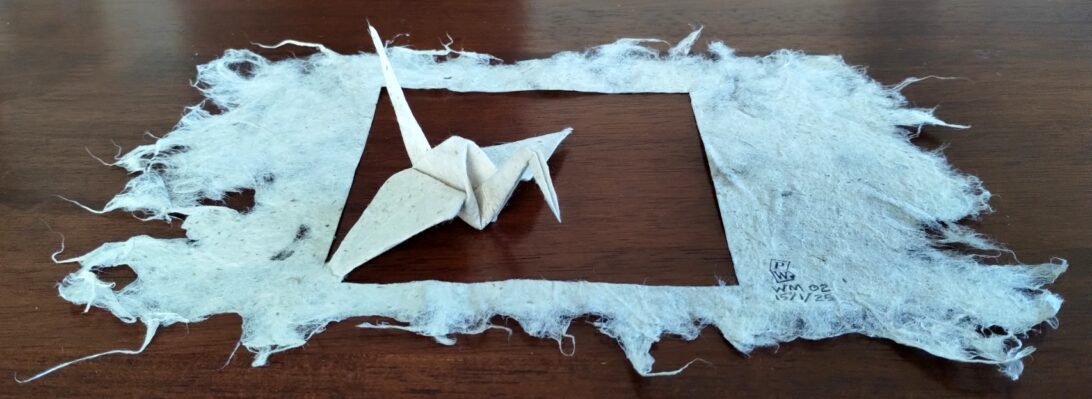
Having made Mulberry Washi, I was trying to decide what i wanted to do with it. I think the larger sheets are currently sheet pulp storage I will re-beat and incorporate into other sheets, but sheets 1 and 2 (names WM01 and WM02 – my nomenclature) I wanted to keep…because.
WM01 is barely there mulberry tissue – I will not fold it, but it is fascinatingly strong. WM02 on the other hand is almost a sheet of paper – thin, lovely deckle edges and loads of character.
I had this idea, based in part on my extensive folding from one of the oldest origami books there is – Senbaruzu Orikata. The idea of a traditional Tsuru (crane – the one everyone including me learns first) still connected by a wing-tip to the surrounding paper began to eat away at me (originally the idea woke me up).
Folding connected cranes is all about the prep, so as not to put too much strain on the part that joins – a single point of failure. Exploring the sheet, I searched my origami squares collection and found that an 11.7cm square could be placed, avoiding the holes and weirder bits, so decided on that size arbitrarily. I also liked how much of the sheet would be untouched, and reasoned I would need it to attach to a backboard if it were to be framed… but I am getting ahead of myself – I had no idea if I could fold or work the sheet at all.
In pencil, I traced the square as accurately as I could, then carefully with a scalpel liberated all 4 edges nearly to each corner so I could see the square border, then gingerly began laying in the pre-creases of a “bird base”. To my absolute delight the paper took sharp creases with NO fatigue. Knowing how the bird base was going to collapse it allowed me to place the necessary pre-creases ONCE, and in the right orientation (mountain or valley).
Once the pre-creasing was done, I then went and liberated 3 of the 4 corners (no turning back now) and collapsed and shaped the Tsuru with no real drama – just being careful of the single remaining attached corner.
…so, having liberated 110g (dry weight) of bast fiber from a lovely bunch of Andy’s mulberry tree prunings, it was time to do something with it. I decided to use half (55g), and added it to a plastic container and added a little water to re-hydrate it.
Using the patented “AndyMallet™”, and a recently purchased Ikea bamboo chopping board wrapped in an old pillowcase, I began whacking the re-hydrated pulp using the hardwood edge of the mallet. The shaping of the mallet is perfect, so much mechanical advantage that the fiber was squished in no time.
After about 15 mins of beating, I did a “suspension test”, decided another 5mins was needed and whacked on for another 5ish minutes. BEATING fiber frays the cellulose tubes, allowing complex interlinking of adjacent fibers.
With a tub of “fluffy” beaten fiber, kept in suspension with Okra slime, it was time to try forming some sheets.
My setup was very basic, and after experimenting with the only “vat” like container I had, I abandoned the conventional “pulling” of sheets in favour of the “pour over” method as a means of testing the pulp properties.
So I had this slightly crazy idea, based on the fact that my son in law (Andy) wanted to prune his small Mulberry tree after it had finished fruiting (apparently the possums are grateful for this years crop).
Figuring the fruiting mulberry (Morus alba or less commonly Morus rubra) is in the same family as the Paper mulberry (Broussonetia papyrifera = Kozo) I thought it would be fun to try and make paper from it. Kozo is known for glorious bast fibers (the inner bark) that is really suited to making fine strong paper. I can hear the experts screaming “don’t go there, it is the wrong plant”, but … meh, time to fuck around and find out.
As a test, I got a single branch, fresh off the tree, took it home and chopped it up into 30cm ish pieces (so they FIT in my pot) and soaked them overnight in water. Next day, using a small sharp knife, I nimbly removed the quills of bark off the sticks, noting how difficult this was, but not damaging myself. (this was not working smart … but I was exploring processes that could be scaled up). I cooked the quills in an old pot on the BBQ with waaaaay too much washing soda (I learned from this) until it was limp and soft, then rinsed, washed, separated the detritus from the inner silky but strong fibers and air-dried the tiny bundle.