
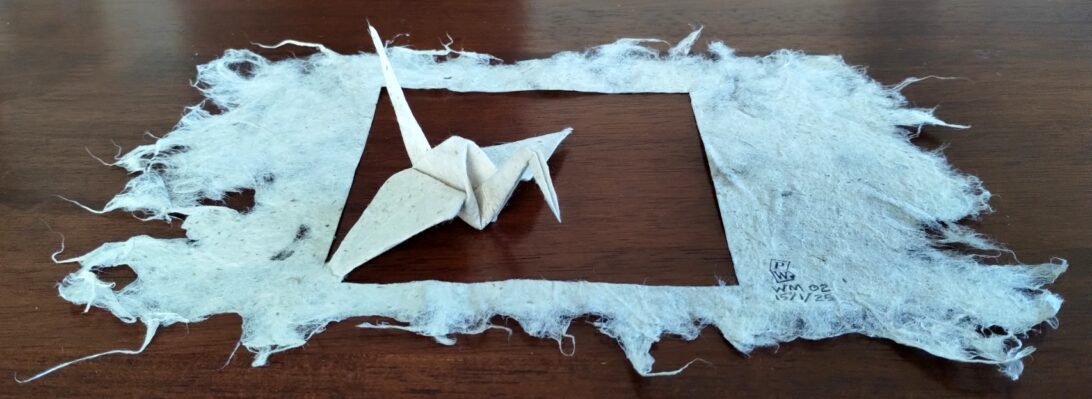
At a recent Papermakers and Artists of Queensland (PAQ) weekend workshop I had the time to explore some early techniques that made “paper-like” ancestors of the modern thing we know of as paper.
I had carefully scraped, cooked and cleaned some Paper Mulberry bast, but left it in bark sheet form, and was interested in treating it differently. Conventionally I would cut it up a little and then beat it until it became uniformly pulpy, suspend that pulp in water and catch thin sheets of it on my mould and deckle.
…but …
In Meso-America (ancient Mexico), they would take similarly cooked inner bark from a fig tree (sadly I think the species they used is now extinct), WEAVE the strips together and then beat it until the strips spread and combine and their fibers inter-connected, making a “pre-paper” surface called AMATE.

I tried this with my mulberry bast – beating the woven mat with my “Andy Mallet” until it spread thinly across the flat-spun organza I lined my wooden beating board with. This was then gently couched between 2 sheets of fine cotton, and joined my paper post in the press to get rid of the excess water.
The result is lovely – with practice I think I could get it thinner and more even, but as an experiment it resulted in a lovely “paper-like” substance that is very strong.
The second such experiment had me lay layers of bark down, changing the direction of the layers each time – when beaten, the resultant sheet spread more, was thinner and a little more flexible when dry – this technique was meant to simulate aspects of the PAPYRUS process – originally made in areas like Egypt from the pith of water reeds, laid in layers that alternated direction and then beaten thin until the fibers meshed.

There are historical examples of both types of pre-paper that are thousands of years old – a fabulous record of written history. In the west, things like Vellum (stretched and dried animal skins) pre-dated what we now recognise as paper, but the pre-papers are interesting in their own right.

I think the “papyrus” process resulted in the most interesting looking sheet – I think it looks a lot “seascapey”, but both are interesting. Mulberry bast, before it is beaten has an interesting texture – just under the 2 outer layers of bark the bas has a “grain” which is lost when the bast is then beaten and fluffed into pulp. I like that these techniques actually accentuated the grain, showing off the silken waves in a beautiful and lasting way.