
30 unit modulars exist in many forms, permutations and complications, few rival “Russian Lilac” for sheer time-consuming brutality:

Designed by Andrey Ermakov, this astonishing spikey ball has been quite a journey. I first added it to my “to fold” pile for a few years now, and then narrowly missed folding it as part of the IOIO (Internet Origami Olympiad) in 2021 – it was the nightmare round 2 task (I was knocked out in round 1).
The FIRST hurdle for folding this is the need to create 30 perfect regular hexagons that are all the same size (I created a few extra just in case shit went sideways). To do this, I cleaved a 2.1:1 rectangle from a 70cm wide roll of white/natural Kraft paper. Using 47 construction lines to form a regular TRIANGLE GRID on this page, I was then able to isolate 35 adjacent hexagons, which I then cut out carefully (scissors warning!!!).
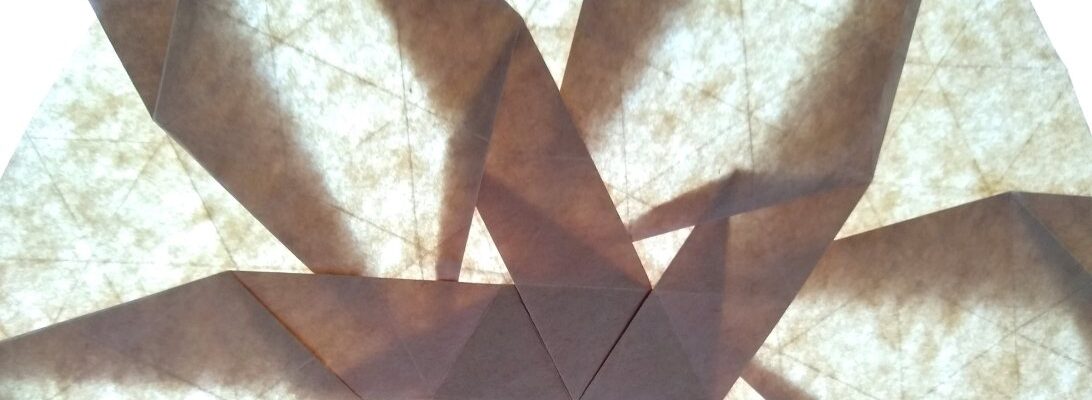
Each hexagon then receives a 16 grid in all 3 axes, then 4 extra pre-creases before you begin unit folding. This totaled 1470 pre-creasing. Having bailed near the end of this year’s “Advent of Tessellations”, determined to return to it after some distance, I am not sure why i then bounced to another triangle grid on hexagon marathon project – I am guessing the time with my counsellor will eventually surface the reasons for the self-inflicted PTSD 😛

To form each unit, each hexagon then goes through 79 processes – all up each unit took me just over an hour each.
The main premise behind “2d colour-change origami” models (of which the flattened unit is one) is that you strategically utilise the edges of the sheet so you can reveal both sides of the paper along it by some clever flanges and flipping. The GENIUS of this model is that we use colour change to (when assembled) establish a colour-change triangle checkerboard across ALL outer faces of the finished polygon. Sadly each little triangle is not SEAMLESS – most are but not all, but based on my experience folding Daniel Brown’s seamless chessboards, I know this provision makes the design infinitely harder.

This required forming sections of checkerboard that are completed by complimentary overlapping bits of adjacent units, while also providing a locking mechanism to allow it to hold together. To my surprise the construction was actually pretty easy because the lock is simple, accessible and it works.
I will admit to using some strategic glue dots to keep gaping seams closed, and also in the construction to ensure the alignment of units was exact. Because of paper thickness, it tries to push itself slightly wonky, so some strategic gluing stops that and ensures edges align and points are sharp.

I have been folding this for nearly 2 weeks, on and off, to rest my hands and stop me going to apeshit, but, now it is together I am inordinately chuffed that I actually made it. Looking close I am also pretty pleased with the accuracy, neat alignment and just solid “heft” of the thing. It has over 2m of paper in it so it actually weighs a lot, feels really substantial in the hand, and in my mind represents a real achievement – given all the accumulated errors that could have occurred with such a convoluted fold process.
