1200: Road To Nowhere

I have this image in my head, of a petty little orange man, walking in circles because he has not realised he in on a flight of M.C. Escher’s stairs:

Oddly … this abstract concept is not that far from what the petty little orange man is actually doing (but, I do not really understand the lure of a golden ballroom), but I digress.

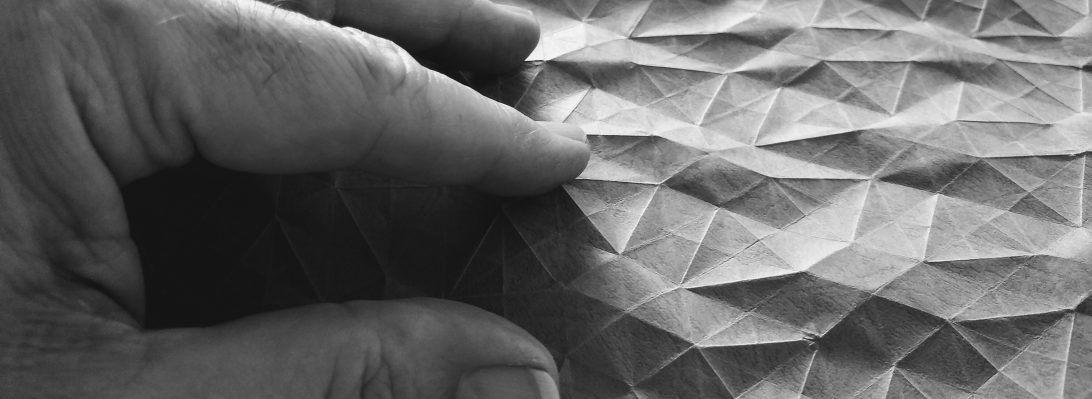
I first saw this model on John McKeever’s Flickr, and think it is a Fujimoto-style set of Escher steps, but the etymology of the model is less clear as it seems to be a variation on a clover-like tessellation, but is deliciously evil in it’s convoluted crease pattern.

I decided I had to try it, but really struggled to understand what the actual floop was going on with the crease pattern – it seemed like the prescribed creases could not co-exist. Naturally I turned to an old trick – I folded a maquette:

After a few days of twiddling with printer paper CP copies until they disintegrated, I finally found a collapse sequence that … somehow … sorted itself out by repeatedly bending back on itself. The real trick was working out which vertices go up and which go down – when you sort that out it is still counter-intuitive … until it isn’t.

I started with a 55cm square of Kraft, using a pencil I divided it into 12th, then trimmed 1 unit off 2 adjacent sides to reduce the grid to 11×11. I then used a stylus to place all the of the pre-creases, ensuring I oriented them mountain/valley as indicated. I was soooo chuffed at how CLEAN the pre-creases were, knowing how important it was to NOT mark some faces that would be solid squares in the final model.

I then had to walk away from it, as pleased as I was with the eventual success on maquettes, committing it to the actual fold is a step that made me oddly nervous.

Continue reading

Chiyogami/Washi Hex-Boxes

When life gives you Chiyogami or hand-made Washi, with a relatively simple twist you can turn it into a hex-box: 

Lovely hand-printed Washi (swirls of fibres, block printed 20+ years ago) and modern Chiyogami (machine made but lovely) are actually fairly difficult to work with because you cannot see the creases and Fujimoto’s hex box establishes a bunch of landmarks to form the base-creases.

This is not a first fold, but the form and ingenious locking mechanism, slight variation to form lid and base make this one of my favourite folds – a jewel box when made from lovely paper.

Want one? Buy some nice paper (A3 or A4 work just fine, this is folded from a “golden rectangle”) and I will make it for you (or teach you how to make it yourself if you are near) – have your people call my people and we will make something beautiful together.

402: Washi Hex-Box

This model combines two things I love about Origami:

The geometry of Fujimoto’s Hex box is wonderful, it provided me the perfect excuse to do that which I have put off for far too long. A colleague (thank you Mrs Erizabreth) gave me a roll of hand-made Washi she brought back from Japan many years ago. She had never worked out what to do with it, having fallen in love with it in a shop, bought it on impulse and had it squirrelled away in a cupboard packaged up as new.

She asked if I wanted it, I said yes (having no idea what I was in for). When she left it on my desk and I unfurled it for the first time I was speechless – hand-made, hand-block-printed, with gold and silver foil, the front face is glorious. Flipping the “paper” over, the texture of fibres is also glorious – both sides a work of art.

I have AGONISED about what I would do with it, and today I finally cut it – it was an important moment in my life. This might sound melodramatic, but I have another piece of washi I bought myself 3 years ago, black with gold calligraphy, that I can still not bring myself to cut. there is a special sort of reverence in beautiful things I think.

Anyway, I decided to fold a lidded box from the first cut pieces for 2 reasons – the hex box is my favourite and the paper makes it sparkle like a jewelled box.

I had a little panic, so mocked up the fold with some scribbled on copy paper – it occurred to me that I had NEVER folded this model with coloured paper – I just sort of assumed it worked itself out and the coloured side would show whilst the non-coloured side would hide itself away. Thank goodness, with a little tweak all worked out well.

There is so  much to love about this fold – it is teachable (I taught my Origami Club how to do it – year 9 boys managed it admirably); all it’s raw edged tuck away inside the body of the model, it’s top and bottom are folded slightly differently but nest inside each other beautifully; the top hex twist is lovely – with this paper it appears puffy and sort of quilted.

I am very happy with this, my first really expensive paper box. It is a gift, I envy the receiver but at least I have more of this lovely paper to obsess about.

148: Fujimoto’s Hexagonal Box

Looking at the options for the box for this month, I stumbled across a design For Fujomono’s hexagonal box and decided to give that a twirl, literally:

A realtively simple fold that is stunningly beautiful – the hex swirl inside and out has a skirt that locks itself into the base – design genius that makes this my favourite box so far.

I think this design is a keeper. The lid is a slight variation of the base, slips over tightly and the finished package is a beautiful sculptural object – it would look lovely in pretty paper and because everything locks in place would be a good gift box also (must keep that in mind)