1202: Pineapple Tessellation

At the beginning of the pandemic, I bought myself a copy of Ilan Garibi’s wonderful book “Origami Tessellations for Everyone”, but looking through recently I realised I had not folded many of the wonderful designs before, so set about remedying that:

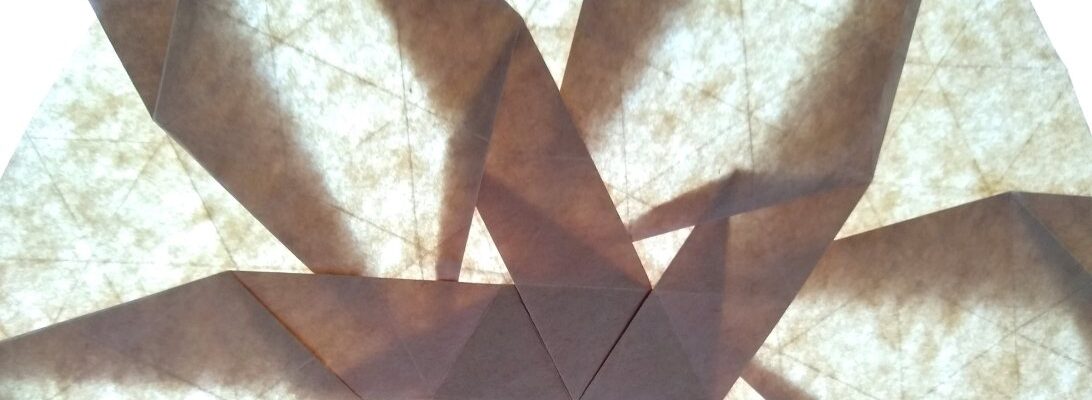
This is a SINGLE molecule of the “pineapple” tessellation. After a simple set of diagonal pre-creases are imposed on a square grid, the first level collapse is really satisfying. You then have to perform a transformation (essentially turning part of the previously collapsed part inside to create the final structure.

You can then inside reverse the “scales” and you have a lovely form that resembles the body of a pineapple, kind of. The molecule tiles a number of ways – given it lies on the diagonal, you can either tile them in X or O formation – I chose to do a 4-molecule O form, just to see how difficult it was dealing with the interactions, but it turned out fairly easily.

By spacing the molecules correctly, and arranging them in an X you can create a rather lovely “Dish” that is dimensional, stands freely, has a satisfying volume and most importantly gives you free paper to shape pineapple “tops” to act as legs.

It was a fun fold, particularly if you accurately place the pre-creases, and get them in the right orientation (mountain/valley) before you attempt the first collapse. It is a terrific addition to the “what can I do with a square grid” pile.

I must explore more, Ilan’s work is well described, challenging but fun to fold.

1057: In ‘da ‘Hood

Exploring Ilan Garibi’s lovely book “Origami Tessellations for Everybody”, the next “family” of folds starts off with “Childhood” and then evolves into more of the same:

childhood evolved
Childhood-Evolved (4×4 molecules)

This is almost a corrugation, as there are nearly no layers overlaying others – the surface treatment is deliciously dimensional, and the distortions are caused by paper tension and torsion of the underlying square-twists.

Childhood Molecule
“Childhood” molecule

I started with standard cotton-based photocopy paper (which for me is a LOT like thin Elephant Hide) and laid in a square grid. Both childhood and childhood-evolved use off divisions. I folded a regular division (halves or thirds), then halved until I was close to the required grid sizes, then sliced off unneeded units before laying in the wedge-shaped mountain creases.

Continue reading

943: Dragon Heart Tessellation

Researching tessellations, I stumbled across a paper, written by Helena Verrill (Queens University, Kingston, Canada) that generally introduced the concept and looked at a number of common tiling patterns, but the first CP is one I had not seen before:

dragon heart

I did a small tester and loved (fluked) the collapse, and decided to scale up to a full A3 sheet, starting with a square grid. Then nested adjacent squares are layed in on diagonals to provide odd inverse hinges.

I am quite happy with this, and if more ambitious, I would fold it much smaller on a larger sheet – it would make amazing dragon skin.

Continue reading

704: (154/365) Shuzo Fujimoto’s Stars n Squares Tessellation

Starting with a square-twist tessellation, you add to the intensity by folding it some more:

Alternating spin squares with stars, you get this nightmare of paper torture. Continue reading

546: Château Chinon Tessellation

Another time sponge, based on a square grid initially that was torturous to fold and pre-crease. Based on Eric Gjerde’s tessellation molecule, it is an amazing use of paper that features largely an “all at once” collapse.546ChateauChinon

Many tessellations sit flat while you do them, their interim stages are still flat – not this mongrel. Once you start, you gotta finish and then work out how to flatten – interesting but not very portable in the end. Continue reading