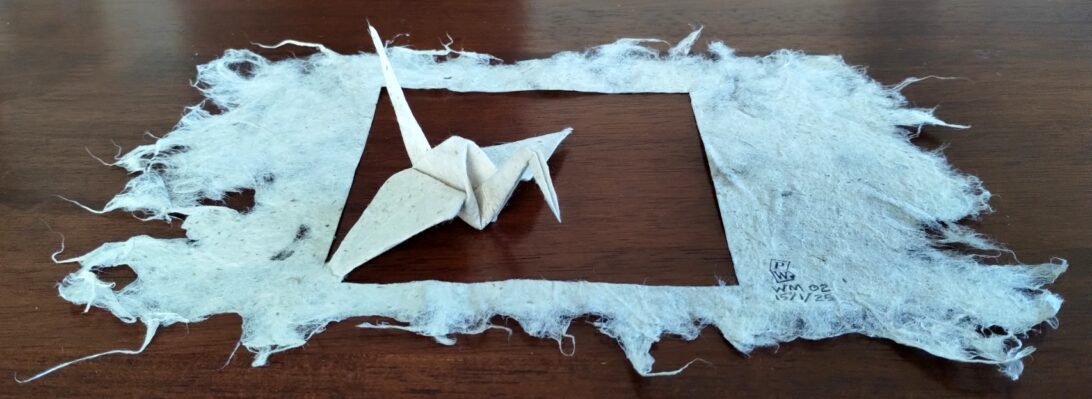
723: (173/365) Feathered Tsuru

Few would argue that the Tsuru (crane) is the quintessential origami figure. Everybody starts there, the form is so familiar and the skills necessary to fold it form the backbone of so many models:

While I have tried many variations of this model, few compare to Riccardo Foschi’s “feathered Tsuru”, a glorious and complex variation with such beautiful wings. Continue reading

547: Stellar

As part of the school’s social justice program, I was asked to come up with a fold for a bow tie that I could teach year 7-10 boys and girls from 3 schools on a Friday afternoon:547StellaBellaFella

Based in part on a technique used by many, but first seen in a video, I devices a way of using a square, hiding raw edges and basingĀ most of the folds on halves (figuring boys could actually fold things in half fairly easily). Continue reading

543: Flock

I try to mark the passing of Hiroshima Day August 6 with respect and effort.543FlockSml

Having folded the traditional 1000 cranes twice in my life (oddly, the second time my cranes were “borrowed” by a then campaigning year 11 for a community project where he received the credit and was subsequently elected School Captain … but I digress) so thought it time to try something new. Continue reading

539: Triple Tsuru

Continuing my exploration of Hiden Senbazuru Orikata (The Secret of One Thousand Cranes Origami), published in 1797 I managed to wrangle a triple Tsuru:539TriTsuru

The original schematic suggests that you use 2 small squares attached to the wings of the larger square, and I cannot fathom whether the dotted lines mean “remove” the unused paper or “hide” it. I chose to hide it.triTsuru

We end up with parent and 2 kids, joined at the wings. The actual folding is fairly fiddly and the paper hiding makes the head/tail of the parent very thick (or was it the paper I chose?) Continue reading

537: Quad Tsuru two ways

Taking a square and (nearly) cleaving it into 4 separate sheets leads to an interesting design dilemma:537QuadTsuru2

When the join is in the centre of the sheet, you can join wings, tails or I suppose beaks together.S10-2

When the joins are at the edges of the sheet, you could join wings, beaks or tails but I went for the symmetry of wings in this fold. Continue reading

536: Double Tsuru (2)

Joined at the wing, this pair of Tsuru (traditional Cranes) was folded from a single sheet split nearly in half:536DoubleTsuru

Taken from “Hiden Senbazuru Orikata (The Secret of One Thousand Cranes Origami)” published in 1797. It is part of a series I hope to tackle…535DoubleTsuruInspiration

The trick is to not tear it as you fold it – the paper tension at the split is tenuous, so requires a gently, deft touch. Continue reading

535: Double Tsuru (1)

Browsing the internet, as you do, I came upon a chance find of an amazing archive of pages from what is thought to be the oldest Origami book published – “Hiden Senbazuru Orikata (The Secret of One Thousand Cranes Origami)”, first published in 1797:535DoubleTsuru

Looks like i have a new project, making Tsuru (traditional Cranes) in multiples on a single (cut) sheet – looks like it is going to be a fascinating ride.535DoubleTsuruInspiration

Continue reading