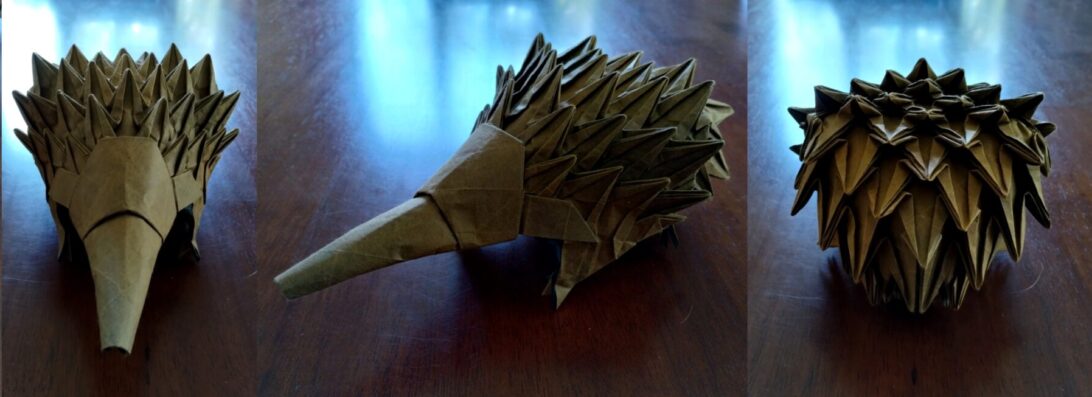
Occasionally I am privileged to be asked to test-fold new models, and I jumped at the chance to fold this Numbat:
As far as I can see, this is the first depiction of this native Australian insectivorous marsupial in origami and the design captures the morpohology and proportions really well.
Starting with a preliminary base, then folding a skewed birdbase, the side stripes naturally emerge in cleverly controlled colour changes, along with the legs, neck and ant-eater-like snout, along with a lovely bushy tail.
I folded this chap from a 40cm square of white/natural Kraft paper (some of my last from the Ikea stash – I wish they sold it again, great stuff) and the fold sequence was fun – some really interesting moves and a good range of skills necessary to complete the model neatly.
I have recently completed the mammoth 50hr+ live fold-along festival called The Origami World Marathon. I folded as many as I could physically attend, and it is a super rare privilege to be actually taught by such world class designers.
I managed about 14 models live, slept some and can complete those missed because, as part of the purchased ticket I gain access to video tutorials from the designers for the next year – win, win.
So a fairly well known fact in Origami circles is that there are Origami Museums, few compare in size to the Spanish one in Zaragoza. When Jo and I had decided to spend time in Barcelona, we discovered Zaragoza was doable day trip from Barcelona Sants regional train station, so a plan was hatched.
Barcelona Sants is a regional rail hub, different to the metro. We will from depart here in a few days for Province, but this station also provides access to many other places in Catalunya and beyond. After locating our platform ( via a very helpful man at the Information counter), we had our bags (and everything else) xrayed before arriving on the platform to find the train already boarding.
We boarded AVE-S112 High Speed train, allocated seats a lot like an airplane, and took off. The train sped underground until it cleared the central city and burst out into the light as farmland flew by. For a lot of the journey the train was topping 295 km/h as it hurtled stop to stop.
After a little over an hour, we arrived at Zaragoza train station, and de-trained, got some refreshments then headed over to the Bus Station, to catch a C1 circle line bus, and rode it the remaining half way around to the terminus. After a brief bit of nav we were picking through the back streets to EMOZ, located on the 2nd Floor of Centro de Historias, Plaza San Agustín 2.
I had been in contact with the museum ever since there seemed a chance for me to visit, and it was lovely to finally meet an online friend named Jesús Artigas. We nerded out a bit, talked about the current exhibition and about Yoshizawa’s works, and particularly the work of Eric Joisel.
The museum has, on display a number of Joisel’s original works, including one of his gnome orchestras, his large-scale Rhinoceros and his large scale Pegasus.
Jesús let us sneak peak in the store room at Joisel’s large Hippopotamus also, all master works from a genius artist much missed.
We talked folding, design, and it turns out he is working on an interesting origami publication of endangered Spanish animals, and asked if I was interested in test folding closer to publication date. What an honor indeed, naturally I said yes. That should be fabulous and something else to be involved in when I finally return home.
We parted company with the promise of future collaboration, then Jo and I took our time appreciating the many rooms of exhibits. It was good to see so many original works from legends in the field, including Victor Coeurjoly, Robert Lang, Junior Fritz Jaquett, Kashiwamura, Jozsef Zsebe, a host of different Vietnamese designers, and even a tiny work from Yoshizawa himself. We are not worthy.
The museum also offers informative information about the paper/folding traditions of many countries. It is interesting that many different schools of folding crafts emerged independently with the introduction of paper and paper-like materials. We also saw some very early traditional folds pioneering skills from historical giants that modern day origami designers stand on the shoulders of.
The feature artist at the moment is Vivian Berty, with a number of rooms devoted to her colourful, figurative and representational varied art practice. Such a riot of colour and range of simple to elegant models, compositions and modular works.
It felt like home for me, to be surrounded by an art form I have spent a lot of my life exploring. Nerd-feasts come in every flavour, and this was one of mine.
After leaving EMOZ, we reversed our journey to Zaragoza Delicias rail station, grabbed a late lunch and then our train back to Barcelona. I am sure I gushed, Jo was very tolerant of a very happy nerd. If I get the opportunity I would like to visit again, as well as explore the other origami museums of the world.
One of many habits I have developed, when travelling, is to “art bomb” the places we stay:
I take origami paper on holiday (like, who doesn’t, right?) and like to hide a finished cute model somewhere in our accommodation, restaurant, ferry, funicular or whatever for either the owner or a subsequent guest to discover – meant as a nice little surprise.
As an Australian, I try to include aussie flora or fauna, and memorize the fold.
If I am to be completely honest, I am astonished I have never folded Jo Nakashima’s “Kangaroo” before. It is a little charmer. I have a pack of indigo Tuttle paper that will be perfect for this, so it is sorted (apart from the practice needed to fold it from fading memory).
Proofing manuscripts that are soon to become Origami books is an interesting (and sometimes intense) business. While looking at a recent draft, I happened upon Nguyễn Tiến Kha’s lovely new “Lapin (Rabbit)” design and new I needed to test-fold it:
This is an intense fold – it eats up so much paper (I folded this little lovely from a 45cm square), but in the end we get a lovely bi-colour rabbit with all its bits in the right place, good proportions (although a little “top heavy”) and (with a little bum surgery) self-standing.
There are lots of origami rabbits, I have folded most of them, and this one is a charmer for a bunch of reasons. The fold sequence is ingenious, intense and really reliant of accuracy early – lots of pre-creasing provides good landmarks later on, and some lovely emergent geometry as you turn things inside out, round and about.
Cruising the socials, I noticed origamist Bodo Haag gifted newly drawn diagrams for a rather splendid whale, and I knew I needed to fold it:
Utilising the back and front colours of the sheet, we have a nicely white tummy and a dark back and tail fluke.
I had a lovely bit of wrapping paper (thx Rachel) and knew it would be lovely folded as something, and as a decorative ocean-going mammal it is perfect.
It is always interesting to receive the latest JOAS Tanteidan Magazine:
On the cover was a model I immediately knew I had to try – Yoo Tae Yong’s “Quokka”.
As far as I am aware, this is the first Quokka design, and wow, what a beauty. The model is fully featured – in proportion to a real Quokka, and even has a pouch.
I am trying to get my brain back – the term has been brutal so I decided some paper therapy was in order. I originally folded this model back in 2011, on tiny paper, and the resultant mess was posted as part of that year’s 365 challenge.
I had vowed to re-fold it with better paper, and I decided to do that today.
I cut a 50cm of pearl coloured Lithography paper, and carefully followed an instruction set that only lasted 103 steps or so (quite quick for a Kamiya model).
I love how this horse seems to emerge from an otherwise non-descript tangle, with glorious and sensibly placed, appropriately muscled wings.
There were 4 hours allocated for the teaching of “Dog”, we finished in about 3 so Satoshi decided to teach a simpler model that he said was the most “realistic cat” he knew – modelled after his own pet apparently:
A simple fold sequence, we have the back of a cat staring intensely away from us, just wonderful. I have seen other session attendee’s models where they added details to the front of the cat (when I re-fold this I may too).
Again, the sequence was fluid, and a joy to follow along with, interjected with banter and casual observations by the master – such a privilege to have been able to fold along.
The star drawcard (for me) was an opportunity to fold along live with Satoshi Kamiya – he taught 2 models and I managed to follow along with the broken English, translator and zoom limitations:
The sequence of most of Kamiya’s models are delicious – so natural, logical and a totally different/unique style.
This is a generic dog, different to the one most recently published and I can see how you could vary the base to get really nicely shaped dogs of many types – this one is a little “husky” like.
I really felt lucky to have been present, I am a bit of a fanboi, but it was intense and wonderful. Matching the master, fold for fold was a rare pribilege. I must re-fold this (as I am not really happy with the head I folded).
Mum had Basset hounds when we were kids – wondrously preposterous dogs with twice as much skin as any dog needs, rediculously long ears and a bark straight from the bowels of hell. We loved the “girls”; they were very intelligent, active and protective (and seemed to delight in sneaking up behind us and barking deeply once, for the effect – I am sure it amused them):
This model is as close to the actual basset hound shape as I have found folded from paper, and the colour changes make this model actually closely resemble one of our bassetts named “Cleo” – lovely dog. The stance is really typical and the placement/proportion of the ears and head are spot on.
Folded from white/natural duo Ikea Kraft, it is a challenging model because of a number of judgement fold steps and some tricky shaping, but i am happy with the result (and hope mum likes it, a gift for her).
Whilst being eliminated from the Origami Tournament, I am still interested in the models being folded by surviving contestants. This week’s challenge was Jang Yong Ik’s :Smilodon” – a “sabre tooth tiger” like critter from time gone past:
The fold sequence is intense – this model ate up a 70cm square of black/natural duo Kraft paper like few other models. The body is thick and heavy, some sections had dozens of layers.
I took my time, considered as I went, determined to succeed on my first fold. In retrospect, using thinner paper would have an advantage in that the layer management would be easier, but the legs would be flimsy and require wire supports – tough for a designer to distribute paper structurally.
In the end, we have a crouching toothy fossil, it was an interesting exercise and entrants did some good shaping to personalise their folds. I enjoyed exploring the sequence.
Madly, I agreed to participate in an international tournament, at the Intermediate level:
Intermediate meant you got a diagram and 72 hours to fold a rendition of it. I decided the “advanced” category was beyond my available time as you only got a CP and presumably relied on the power of prayer.
I gave it a whirl, went for crisp and accurate, but played a little with the flowing style of mane. It was loved by nearly noone who voted – fair enough. Other, less well folded versions (in my opinion) got more “likes” – social media is like that. Useful punch in the face, thanks.
Round 1 of the tournament done … and I am eliminated. Time to focus on more important things.
Further exploring all things equinine, I realised I had never folded Satoshi Kamiya’s horse:
Central to this horse design is a lovely mane, but the volume and proportions of this model are amazing, the base it originates from is immediately “horsey”.
Shaping matters, and I think I have been a little clumsy, but I suspect some of the fat is the paper – crisp 70cm kraft – I think if I had used a thinner/more textured paper the result would look less like a plastic horse.
There are lots of really challenging moves in this sequence – gathering the pleats to allow you to fan out the mane while not distorting the outside layers in mindboggling – there is LOTS of paper hidden, and I think my accuracy for this, the first fold, was pretty good.
I must chase up a copy of Issei Yoshino’s book – that horse has a mane that apparently inspired Satoshi to design this one.
Always on the look out for an elegant depiction of a horse, a contact on Insta posted his fold of this model (a model I had not seen before), and I knew I had to try it:
There are many stunning origami horses – my favourite 2 of note are David Brill’s (folded from a triangle) and Satoshi Kamiya’s (which I have yet to fold).
This model has the proportions and majesty of a fine racing horse and the fold sequence is a lot of fun – you have to be accurate and exercise restraint throughout to get an elegant form.
Folded from a 40cm square of Tant (a little heavy for this design, but I liked the colour and texture so persisted), I think I have a new favourite – such a beautiful horse, and lovely internal structure also.