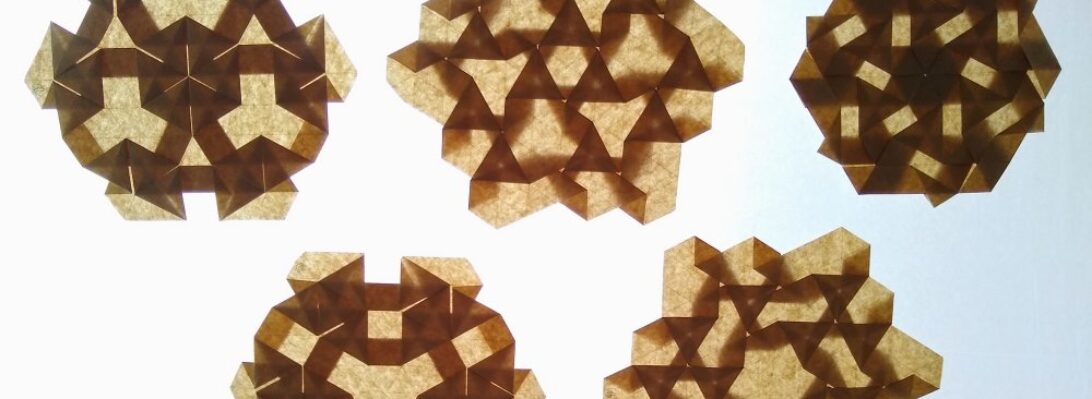
This is ‘Red Flower’, the base fold of which there re many variations, but the base molecule is based on a square grid and (for single molecule at least) simple to pre-crease and collapse.
When you scale up, accuracy shows itself as important – slight errors mean that the internal collapses twist the whole sheet out of shape.
Looking for something to de-stress and unwind to after a brutal term, I turned to “The Works of Satoshi Kamiya II”, and a model that I was astonished to find I had never tried – his hermit crab:
Starting with a 70cm square of natural/white Kraft paper, the fold was challenging as you allocate one side of the sheet to the crab, the other to the shell. Via a fabulous fold sequence, you tease legs, claws, antennae, eyes and mouthparts while delicately colour-changing the rear and then spiralling a shell as his home.
This is, (der), genius design – I always am amazed with Kamiya designs, and the elegance of the developmental sequence – as if the journey is every bit as delightful as the destination.
I am trying to get my brain back – the term has been brutal so I decided some paper therapy was in order. I originally folded this model back in 2011, on tiny paper, and the resultant mess was posted as part of that year’s 365 challenge.
I had vowed to re-fold it with better paper, and I decided to do that today.
I cut a 50cm of pearl coloured Lithography paper, and carefully followed an instruction set that only lasted 103 steps or so (quite quick for a Kamiya model).
I love how this horse seems to emerge from an otherwise non-descript tangle, with glorious and sensibly placed, appropriately muscled wings.
When a legend graciously shares hand-drawn diagrams for a lovely simple Eastern Dragon, one simply has to give it a go:
This is an “Eastern Dragon” – interestingly most people in the west believe you need to staple wings on such a critter so that it can fly. Our eastern cousins accept that this sort of critter can fly, wings are not necessary for this activity.
This design was recently shared, luscious hand-drawn diagrams from @brianchandesigns, a gracious and fabulous gift to the origami community.
My Mum had a large carpet snake take up residence atop her hot water system. Apparently he (she? who can tell?) was gentle, sleepy and knocked off some terracotta plant pots in his quest for a coil-spot:
Over a period of a couple of weeks, he moved about, basking, slithering and generally being a snek, then he buggered off (as they do).
Our local community Library has display cases, I have more origami models in storage that I can count any more so offered to provide some models for a month or so for a display:
The interesting part of this was selecting a variety of models to demonstrate the breadth of the discipline. The challenge was to select only enough models to fill the small display cases.
I decided on a varied collection of single sheet figures, modulars and old favourites, the mix is eclectic and dizzying.
The exhibit is on display at least until the end of August, possibly longer.
A group of mates has, periodically over the last few decades, gotten together in a smoke-filled room to play a board game. Not any old game, but “Dogfight” – a dice-based, card controlled WW1 battle of the airspace over Europe.
Although most of the players were well passed their fifties, we squabbled like little kids, goaded each other fearlessly, preened and peacocked at our prowess and got nit-picky about the many nuances of rule variations hard won.
It was honestly some of the best fun to be had, and the chaps were good sports, one and all. In January, one of our quartet passed away. “Dr Winston O’Boogie” (Michael) flew off into the sunset for the last time to great fanfare.
We have met since, dragging a young buck into the fold, and played until Michael’s house (the home of our epic aerial battles) was finally sold.
Tonight is our last hurrah!
I have struggled to find a suitable way to celebrate such a wonderful partnership, but turned to Origami, as is my want. I wanted to fold BIPLANES for the original pilots, and a smaller plane for the new recruit, and have really struggled with these models. The Biplanes are designed by Marc Kirschenbaum. I wanted to fold them smaller but failed many times, only being able to manage them from 60cm squares (and not very tidily sadly) – red, naturally in honour of Von Richtoffen (or Snoopy, take your pick).
The smaller plane is “Avioneta” designed by Eduardo Clemente – a charming little fokker.
I hope the guys like them. I remain forever grateful for the opportunity to act like little kids when surrounded by the wonder and majesty of imagination, fun and friendship. Chocks away Chuck, fly true one and all.
I am a firm believer that people learn something important when they try to do something they are not good at. I have recently bought a Theremin, and I want to pretend that I am anything but not good at playing it, but, like, it is hard to master:
I noticed that a Theremin has a distinctive shape: an upright antenna that you use to control pitch (the high-lowness of a note), and a horizontal antenna loop you use to control volume. To my (not so great) surprise, I discovered that no one had yet done an origami model for this thing, so set about having a go.
I started with the fish base, long flap for the pitch antenna, long flap for the stand, then 2 shorter flaps become the volume loop. Some accordion pleating and the basic morphology is there. You can (I hope) see the development in the sequence below:
It is a start, I might try to refine it (add knobs, refine the antennae, etc). Happy with v1.
I have discovered I a very low tolerance of boredom, I neeeeeed to be doing something most of the time. When my students are doing assignment work I make myself available for consultancy and need tasks I can drop in an instant so I can help them – origami is often my goto:
This is a re-fold, but I like it more than my first fold. I chose 5 sections (that together become a 10:1 proportion rectangle) for ease of transport during the folding process. White/natural Kraft paper (23cm on the narrow), and some care and attention to accuracy. This little beauty is the result.
It is rare to see happy dragons – they usually are trying to be ferrocious and scary – this dragon reminds me of a puppy, a mischevious ball of energy that is waiting for you to throw the drool and scorchmark-covered stick again.
Origami designer Fergus Curry shared with me the diagrams for his Rhombic Triacontahedon, I was determined to give it a try:
30 squares in 5 colours, some clever unit folding later and I had the bits needed to construct this little gem. A positive tab-pocket mechanism, some strategic placement of colours and pretty soon you have a lovely sphere made of rhombi. [edit]: A friend (JZag) pointed out this is a D30 (DnD reference there) – nice and nerdy.
When I saw the folded form I thought there must be some trickery here:
All I had access to is the crease pattern (CP) for this model, and, given I am trying to develop my CP solving skills I thought it fair game to give it a try.
Based on a 16×16 grid, some strategic box pleating and an ingenious colour change we have a classic music stand, 3 shapely legs and a piece of sheet music that is a different colour to the stand – magic.
I like this model a lot – it just sort of coalesced in to a successful model for me, although the first fold was on paper that was same both sides but I could see the potential for colour change and had to fold it in duo paper,
A few years back, I was gifted a portfolio of amazing vintage paisley paper by the Albions. I have held back folding it until I found something that would do it justice:
I pulled a sheet (there are over a dozen different paisleys in the folio), it opened up into a large sheet that I derived a way of dividing it into 30 equal squares – the basis on this kusudama.
This is a stellated dodecahedron, with lovely ridges, pentagonal faces and a wonderfully tactile design. 30 modules, based on 60 degree division, wonderfully deep pockets and positive lock, initially it is easy to put together. You can have a go yourself: https://www.youtube.com/watch?v=MzeQBFay8NY
There were 4 hours allocated for the teaching of “Dog”, we finished in about 3 so Satoshi decided to teach a simpler model that he said was the most “realistic cat” he knew – modelled after his own pet apparently:
A simple fold sequence, we have the back of a cat staring intensely away from us, just wonderful. I have seen other session attendee’s models where they added details to the front of the cat (when I re-fold this I may too).
Again, the sequence was fluid, and a joy to follow along with, interjected with banter and casual observations by the master – such a privilege to have been able to fold along.
The star drawcard (for me) was an opportunity to fold along live with Satoshi Kamiya – he taught 2 models and I managed to follow along with the broken English, translator and zoom limitations:
The sequence of most of Kamiya’s models are delicious – so natural, logical and a totally different/unique style.
This is a generic dog, different to the one most recently published and I can see how you could vary the base to get really nicely shaped dogs of many types – this one is a little “husky” like.
I really felt lucky to have been present, I am a bit of a fanboi, but it was intense and wonderful. Matching the master, fold for fold was a rare pribilege. I must re-fold this (as I am not really happy with the head I folded).
Jeannine Mosely is a legend in the modular origami world, and her early morning session was one I hoped to be awake enough to follow:
This nightmare of a model has 12 modules (4 colours, 3 sheets each), and the actual module is really simple (based primarily on a 60 degree corrugation through a fan fold on a 1: root 3 sized paper).
Part of the session was devoted to a neato method of cutting a square down to the correct proportions, a small time in folding the module and the balance in construction, which is a bit of a mind-fuck.
Once you “get” the interleaving, it sort of makes sense, but the shape is not stable until the last colour goes in, making construction really fiddly.
The resultant model is wonderful, and I know I will fold it again (I might choose nicer colours, and perhaps make it a little bigger). Jeannine’s instructions were clear and she has a good common sense presentation style.