131: A Bit of Bull

Given my (perfectly reasonable) obsession with cows, it is surprising that this is one of only a few so far:

A rather cute water buffalo bull, head down, beautiful horns, bum up

A simple, figurative fold after a huge and exhausting day.

130: Cylon Reading it’s Script

Tuesday evenings for over a year now a mate and I get together and watch 2 episodes of Battlestar Galactica, gradually wending our way through the seasons. Tonight is the final 2 eps:

I like the idea that the CG extras (robot Cylons or “toasters” as they are lovingly referred to) would have to check the script to determine their cues to enter, gesticulate mecahically and kill all humans, so I modded a fold of a german person wearing a hat reading a newspaper to suit:

…squint, look at it in poor light, chemically enhanced and … you got it, right? Well, it is sort of figurative, and sort of works – I really wanted to do the whole cylon centurion but could not find a fold that worked.

If you have not seen the more recent incarnation of BSG you really should – it is landmark Sci Fi, I like it that episodic drama can literally take your breath away, move you to care about the characters, make you question things and be so danged entertaining to discuss.

129: Making a Spectacle

Now I had this idea that with box pleating it should be possible to make life-size spectacles:

So I set about experimenting, discovered that I could form 6×6 lenses, a nose bridge and some reasonable length arms with a 4×1 rectangle cut from an A3 sheet:

Quite cool – an original invention, chuffed with the result. hope you like them also – the ultimate in UV protection (and all light for that matter)

Don’t pretend like you do not want to look this cool 😛

And for those faithful following this nonsense, here is my crease pattern/plan so you can have a go yourself:

128: Mother’s Day Brooch

Mother’s Day is a chance to do something nice for Mum, because…. When your Mum is going to be overseas, it takes planning for that to happen:

This first fold was completed a couple of weeks ago – snail mail to the UK is slow, so I needed to make the coloured ones for cards in time for them to arrive today:

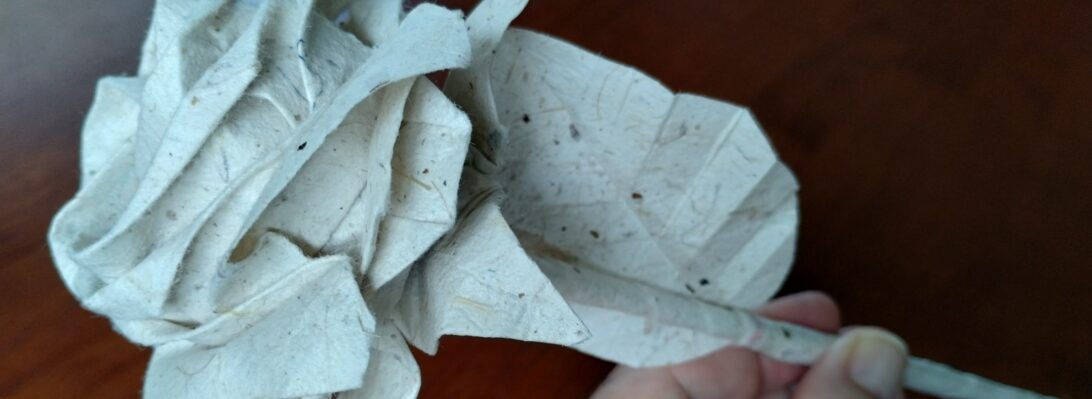
I made a card for each (Mum and Mum-in-law), hope they like them. The coloured roses are rather special – made from imported Yuzen Washi, mounted on to blank cardstock I think they look lovely.

This is a variation of a camelia fold I have yet to try. With 2 colour paper the leaves would be one colour and the rose another, neat:

Designed by Sy Chen, YOU should have a go at this yourself – it is simple and the result is lovely. I am sure your mum would love it – go here for a video demonstration

127: Baby Elephant

This lovely baby elephant approaches the form from an A4 sheet, uncut:

I like this model a lot, the shape, position of trunk, tail and ears remind me of a young elephant and there is lots of paper so the potential to massage in detail and character are rich – very clever.

Why a baby elephant? We helped daughter daughter and her fiancée move into their first unit last night – she has always loved and collected elephants and so it seemed right to send her off with one. The house will be quieter and less interesting without her around. Love you Liz xoxo

You should try this one for yourself – be careful, the instructions are in Danish – I love the google translation engine – littoral translations are often hysterical – my favorite “45: Inner Crack rump and tail.” which means “reverse fold the tail” but it works for me on a bunch of levels.

126: Skier

The Elias base is a great one for figures:

This delightful downhill skier is a fine example – I like the posture, the arm positions, it looks like he is on motion. Folded from “More Origami” by Robert Harbin, another application of the Elias base. A fairly simple fold for a hectic afternoon/night, hope you like it.

125: Snapping Turtle

The “Hare and the Tortoise” have a lot to do with what I was involved in today:

Our school had their inter-house cross country run. I was the far checkpoint and saw some hares and a LOT of tortoises – you get that, they are teenage boys after all.

This lovely turtle caught my eye for the shell, a delicate pleating pattern held in sort of 3d by side pleats, nice. It has all toes, a cute tail but the head (as diagrammed) is rather featureless, sadly – should I fold it again I think I would re-work the head completely as there is plenty of paper there to so some nice features.

Designed by John Szinger, you can have a go at this yourself here

124: May the Fourth Be With You

Now the date is a word-play on a classic Star Wars line, and what better to celebrate Star Wars Day than with C3P0:

This is a mask – even from an A4 sheet it is quite large – I Hazard to suggest that an A3 sheet would make one that was wearable. Fairly happy with it – simple fold, busy day.

123: Sparrow

Looking for an easy model, busy evening – this model has 20 steps, each simple – the result, delightful:

I like this model a lot – I can see plenty of modelling potential – the wings, it’s beak, lovely plump body, under-developed feet – neat and a really different approach to constructing a bird – many steps done by judgement (rather than landmarks) so lots of potential for character – mine looks like a soon-to-fledge youngster.

122: Geiger Xenomorph (alien)

I loved Ridley Scott’s “Alien” – so dark, terrifying and it introduced a much reprised xenomorph originally designed by H.R. Geiger.

When I first saw the instructions for a paper xenomorph (in Spanish) I filed them away in the “yeah, prolly not” folder.

Conventionally the diagram should have symbols to reinforce what is happening (sometimes with words also, except these were in Spanish). First exception to the rule was a TURN OVER with no corresponding flip symbol!!! Grrrr. Following my realisation that I was folding the wrong side, I tried again only to be baffled by “Quedan la dos solapas mirando hacia la derecha” describing a collapse, followed by “Introducir las solapas dentro de los bolsillos” to describe a pocket tuck … poor paper (and finger tips) by this stage. Thank you Google translate.
Now I admit I broke a rule here – I got part way towards collapsing the base and realised I missed an instruction to open some side flaps so did all the nasty folding over the top of some snarly pre-folding instead of on the yet-unfolded side. I discovered this when i opened up the model expecting to find pre-creases only to find none – oops. I was determined to complete this model, so I started again – so sue me.

This is AMAZING – appendages, tail (ouch, that was painful to fold at this scale) and I re-worked the head to be a little 3d and characteristically domed – very pleased with this model. For an A3-cut square to reduce to a model barely 7cm tall, there is a LOT of paper torture, thank goodness for fingernails – I am amazed the copy paper did not simply disintegrate (it would have had I used the model I folded in error first).

For all you Alien fans out there, this one is for you (in commemoration of the theft of a classic line in the movie “Paul” I saw last night – “get away from her you bitch!” – lol.

121: Lang’s Rabbit

“White Rabbits” for this month is provided by Robert Lang:

This beautiful rabbit is my favorite so far because of the shape and detail. This is the Year of the Rabbit also, a happy coincidence.

As a first-fold, I found It torturous to fold – Mr Lang, your instructions 21-24 were baffling, and three times I put the model down, contemplating abandoning it – the left side suffered so much paper fatigue by the time I finally understood where the fold ended up that it was fraying and beginning to give on a major crease (you can see the resultant stress in the middle photo of the dev series below) – luckily in the final model you cannot see this but … gee wiz it was nasty! In retrospect, however, I understand how difficult it would be to diagram and explain, the paper inside the gusset goes to hell and you sort of have to sink-crush-twist to let it sit flat.

I wish I had chosen a larger bit of paper for my first fold – an A4-cut square made this very fiddly and it was a challenge to keep points sharp and creases crisp – especially in the final halving of the model prior to body shaping (I did this very carefully as it looked like it would split along the back (danged copy paper again is an issue).

Very happy with this as a first fold – learnt lots (including a confirmation of the genius that is Robert Lang). Folded from “Origami Zoo”, I will be folding this one again I think as it is a keeper.

April, Done and Dusted

PHEW!

Looking at this collection of models, I get a little wobbly to be honest. Laying them out on the floor to photograph them I realised how much time I am sinking in to this project – not sure if that is sustainable. Maybe more “rock” origami is required 😛

There were some seriously snarly models this month, many personal milestones, it has been an interesting ride so far – hope my patience, abilities and selection of as yet un-tried models lasts the distance. I gotta do some simpler ones I think, too many Joisel’s or Lang’s in a month is a recipe for fatal paper cuts.

Hope you, the blog reader, are also enjoying the journey.

120: Joisel’s Goldfish

Ending such an EPIC month, I thought it appropriate to try a model from Eric Joisel – this is my first-fold of his Goldfish:

Now I know I could have modelled the body a little more, and Eric himself poses a design challenge to put in a nice Davor Vinco-inspired eye, but I am pretty happy with this as a first fold – I learned a lot by folding this, and next time I would make it smaller and much more 3d

Folded from an A3 cut square, using an odd asymetrical triple preliminary fold out of an eccentric pony base, the model has a certain fluidity to it, and seems to fold itself in places – true genius of design.

I like that the tail, although again asymetrical, is complete both sides, and there is lots of opportunity to pose fins, and shape mouth, nice

You can have a go at this, it is fairly straightforward (apart from when it is not) http://www.ericjoisel.com/ps_assets/pdfs/fish.pdf

118: Grammophone

In simpler times, music was encoded onto black plastic discs as bumpy valleys a needle would bounce along to extract the sound. In even simpler times that sound was amplified by a large cone, no electricity involved at all:

These days it is all iPods, mp3s, downloads and stealing music – sometimes the older, simpler times were best – certainly stereo turntables create a lovely chocolatey sound that modern digital sampling techniques have lost.

Why a grammophone? the kids at school perform in the formal concert tonight – the symbol of music for me is “His Master’s Voice” which was a grammophone with a dog looking quizzically at it.

This is an interesting box-pleating exercise that at almost every step looked like it was going to hell in a hand-basket. The final opening of the cone was a revelation.

Amusingly my daughter saw on my screen the words “Pagina precedente” and “Pagina successiva” and immediately assumed I was looking at something naughty – when in fact the instructions were in Italian. Folded in 1/12ths, with an interesting collapse to put the record on the turntable first, I like this a lot and hope you do to.

You can have a go yourself also: http://www.origamidauria.it/diagrammi/diagrammigrammofono/grammofono1.htm