Last night (25th March) was Earth Hour. Between 8:30 and 9:30pm we turned off our lights:
I decided to try and fold something by torchlight … great plan Einstein. Continue reading
blah blah blah, about nothing in marticular – may contain traces of aaaarrrggghh
Last night (25th March) was Earth Hour. Between 8:30 and 9:30pm we turned off our lights:
I decided to try and fold something by torchlight … great plan Einstein. Continue reading
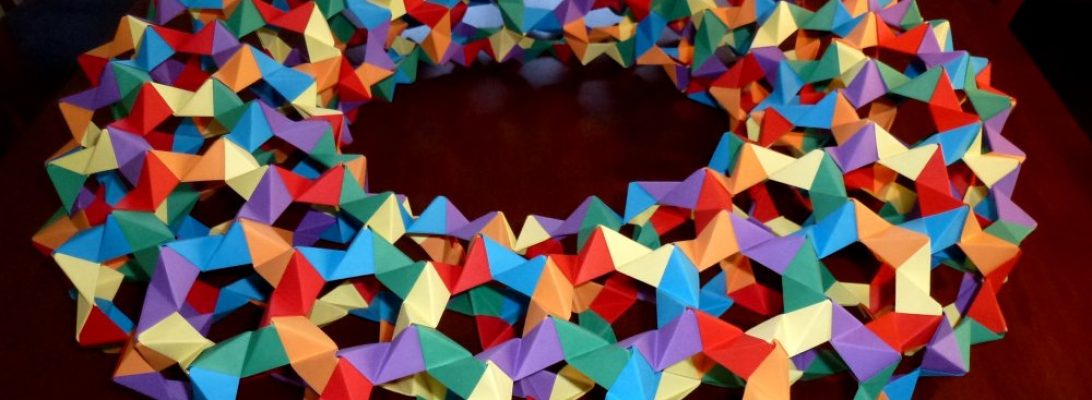
As a teacher and pastoral care “tutor”, I am always looking for ways to get kids working together. At the beginning of the year the tutor group room is a mixed-year level (6-12) mixture of strangers and established friends so “GTK” exercises (Getting To Know you) are great icebreakers if you can get them actually talking and working together:
A few years back I struck on an idea to get kids collaboratively folding an origami mega-structure. The model is fairly simple – I taught the newbies (in this case the year 6 and 7 students) a simple modular unit. They then had to go teach another kid in the group, who in turn taught another. The central metaphor is “the WHOLE is greater than the sum of the parts”, “many hands make light work”, “we are as strong as the weakest link” … and so on.

The Chinese Zodiac is rich with myth and legend, most cultures are full to the brim with such fancy. Chinese New year is based around the Lunar cycles, as such seem oddly placed to us westerners:
Moon cakes, yum cha, char sui hanging in a chinese butcher’s window, the red of firecrackers, the noise and smoke of a dragon dance – all wonderful to be part of. Most cities have a “China town”, in Brisbane it is a section of Fortitude Valley – these areas come alive at this time of year … mmmm, need some dim sum and a nice pot of jasmine tea. Continue reading
Look away, look away … we are going to need a bigger boat:
Interestingly, people’s opinions of sharks in Australia, particularly by those who do not live here, varies from reality markedly. One would believe, if one believed what you see in the media, that sharks are a problem, everyone gets attacked – this is far from the truth.
Although this is a stereotypical tale of woe, I was interested in the folding sequence as each of the tree parts use different bases, wildly different techniques initially and yet there is consistency when you get to the final shaping. Continue reading
In the United States of America on this day they are inaugurating their 45th president – one Donald Trump:
I _want_ to congratulate him and his party on a campaign well fought, policies well considered and popular vote being a landslide but sadly none of these seems true from where I sit.

Looking for a model to express how I feel about the incoming, from my ivory tower over here on the opposite side of a planet suddenly not big enough to place me a safe distance from him, I came across “flipping the bird” by Paulius Mielinis. Whilst only a crease pattern (CP), I could sort of see the parts of the model in among the creases. It took a little wrangling to work out how to collapse and hide unwanted paper, make the digits clean enough to be recognisable. Continue reading
Emergent behaviour is fascinating, apparently where these Japanese Macaque monkeys live gets snowy in winter, they have learned that sitting in thermal pools near bathhouses (Onsen) is one way of staving off the cold:
This is Fumiaki Kawahata’s Japanese Macaque – a model I had intended to fold ages ago because it was in a Tanteidan I had shelved. Continue reading
Returning to work, we balance between the stinking hot outside temperature and the painfully cold airconditioning (yes, I know this sounds like a first world problem, and it is), but I decided to fold a critter that has evolved to put up with intolerable temperatures:
This is Jo Nakashima’s Penguin, a lovely little model with a blocky, cartoony feel to it. Continue reading
This is Hoang Tien Quyet’s Shining star, a multifaceted recursive fold that is somehow appropriate for today, the anniversary of the passing of David Bowie:
2016 was a difficult year for me, and there remains 2 things that I am still struggling to come to terms with: my father’s passing at Easter and Bowie’s Passing in January.
So I have more or less committed to another 365 Origami challenge. This is not a decision I have taken lightly (unlike the last time, in 2011, where I had NO IDEA what I was getting into).
For those unfamiliar with the concept (as I see it), I will endeavour to fold a different Origami Model every day this year – 2017. As in 2011 I will ensure that the models are things I have NEVER folded before.
Some models will be simple, some less so and others far from it. Time permitting I will do a mix. Check the tags for the designer, sheet shape, base (if any) and the duration of the fold.
My nomenclature this time around is complex. I was up to novel model 550, so the current 365 series will look a little like 551 (1/365), 562 (12/365) and so on – keeping track of both numbering systems is a pain I know but…reasons. It will also seamlessly allow me to continue folding and blogging after the challenge with continuity. Remember, only models I have never folded before get a number, so from time to time there will also be un-numbered posts.
This blog posts automatically to Fakebook so friends get a headsup when the day’s model is up. I am trying to be strategic also this time around, and have a number of models in reserve, folded and ready to go for those times when it gets busy, or I am away, or whatever.
Last time, in 2011, the journey was interesting, I learned a lot and the business helped me be more productive in other areas of my life – I am hoping for similar flow-on benefits, along with a further growth in my skills.
Please feel free to leave comments. I will probably also Auction off selections of this catalogue for charity as I did last time around – we shall see.
Naturally, I blame Canada, as any good Southparkian would:
This is Inayoshi Hidehisa’s Maple Leaf chopstick holder but I rather think it works (at this scale at least) much better as a bookmark. Continue reading
…so apparently, like, on the internets and stuff, Tiny Sneks are a thing, right:
This is Gen Hagiwara’s cartoon snake, a cute little model with lovely googly eyes and a smile.
I made it tiny… because. Continue reading
When my sister in law went to Nepal, she found some rather charming Lokta paper, hand-made with block printed gold floral designs. She carefully transported it back with her for me to wrangle. I had a modular in mind and the orange Lokta seemed the obvious choice:
This is Miyuki Kawamura’s Mummy Star, a startlingly complicated modular in 30 pieces. The technique of folding splayed fans, then folding them back on themselves gives the appearance of “wrapping” or bandages I suppose (think Mummy Movie). Continue reading
I love models by Robert Lang, I find I fold them when I need order, therapy, calm. This is a collection of his Orchids, described in his book “Origami Design Secrets”. Something about the mathematical elegance of this flower lends itself to careful modelling and pretty staging. I had a bunch of opalescent 6″ squares in delicate pastel colours so originally folded separate flowers and tried to attach them in a sort of free-form montage.
They look better on a stem, so re-thought the mounting, used florist’s wire and tape to build a plausible “spray” and (shhh) used some craft glue to affix the flowers to the ends of each stickey-outey bit.
Working to the diagonal here, with an odd number of blooms works quite nicely I think, coupled with the corrugated (I folded a fan) hand-made gold-flecked tissue the total scene is quite pleasing. Continue reading
A friend (waves at Roland!) excitedly showed me a new app called Fyuse that allows you to scan objects and create interactive 3D photos of them.
For ages I have been increasingly unhappy with flat photos of really complex origami models and this tool seems to solve that problem, so long as the lighting is ok.
Unlike panorama software where you pan scenery and it stitches a long photo into a surround-scape, with Fyuse you focus on the object, moving the camera around it.
You can change the camera angle and do other things to enhance the photo but it is pretty neat – I will definitely experiment with it more.
If viewing this page on a mobile device, tilt and the images move with you in a sort of augmented reality sort of a way – otherwise drag with your mouse pointer to view these models for all sorts of angles.
I like that you can use a flash, move the model as you pan and that it allows you to see the nooks and crannies that would otherwise not be represented in a conventional flat photo
Now I am not of the generation that grew up with Pokemon, but seem surrounded by adults that were. Fandom/enthusiasm takes many forms and the latest augmented reality game “Pokemon GO!” is so hot right now I felt I had to fold a poke-thing because…reasons
I had seen a video tutorial from Tadashi Mori on a complex model called “Charizard” so thought I would give it a go. Squaring up a large sheet of crumpled VOG paper (I used red, the critter should be orange – not sure if it matters) and began folding.
Turns out the tutorial was in 3 parts, and the model was really challenging, but I think I managed a reasonable rendition of the critter. Continue reading