303: Llopio’s Moment of Truth

The croud erupts spontaneously with “Olé!” as Llopio narrowly dodges the bull calf’s first charge. His grandfather’s matador cap, too loose for him, slips and obscures his vision, there is an amateur swish of a cape as the bull’s developing horns pass too close for comfort, quick step out of the way and Llopio is finally a bullfighter.

This is “Llopio’s Moment of truth” – the reason I bought the British Origami Society’s compendium of Neal Elias figures. There is much to like in this complex box pleat. from one piece of paper emerges a Matador, Bull and the Cape that separates them.

I like how there is movement, you can sense the drama, a fitting end to my exploration of Neal Elias’ work. This fold is challenging, so much of the design is “mystery meat” where you just have to sort of “improvise” – you would not want to fold it much smaller, the manipulation of layers in the bodies is intense and fiddly and it is not immediately obvious what is going to be what until near the end.

Interestingly, only the matador is box pleated – unusually you torture 2 water bomb bases to get the bull and cape so this is a nice fusion between pure box pleating and free-form sculpture. Happy I have folded this, apparently if you fold it with duo paper the cape ends up being the alternate colour – wow.

302: Pereira’s Jack In The Box

If you were ever after proof that “magic happens”, here’s your proof:

This masterpiece of design by Hugo Pereira is a Jack-in-a-box, complete. those who have been keeping up with this blog will remember a previous Jack in the Box by Max Hulme and I must admit I like this one better.

The design engineering alone in this model is breathtaking, from the box to the spring and then to the jack, the details here are lovely and structurally amazing.

So many technical elements here, from intense closed-sinks, folds that cause automatic puckers in the spring and just when you think you are near the end a tight pair of accordion folds to make the arms in almost Elias style.

I am so stoked with this, as a first fold. After an hour of pre-folding, the actual collapse took relatively little time considering the complexity of the model. I had relegated this model the “yeah, prolly not” pile because it just looked too hard – indeed, some of the manoeuvres only make sense if you look before, after and what that part will eventually be used for.

Sense of achievement – tick 🙂

298: Violinist

When I saw this design I knew I had to try it:

Made, oddly, from a “T”-shaped box pleat, designed by Neal Elias in 1971 to celebrate the then popular violinist Yehudi Menuhin, this is a masterpiece of miniature modelling.

We have a violin perched on a shoulder, being held by that hand, a bow hand complete with bow, a serious head tilt, trousers, coat and even shoes! He also free-stands, which is all the more remarkable.

Seriously happy with this fold, I was convinced it was going to hell in a hand basket at 3 junctures when the instructions did not patch what the model had (flaps and creases in different orientations), but in the end it just sort of worked.

Interestingly, it was not all that hard, well, it seemed that way to me – given I had never attempted box pleating before the 365 challenge, I guess my skills have improved, which is a good thing.

297: Taxi!

In old Chinatown, when someone wanted to travel in style, they hailed a “coolie” pulling a rickshaw:

This picture was common in days gone by, these days the hustle and bustle of bicycles, motorbikes and tuk-tuks has replaced the hard work.

This is Neal Elias’ “Coolie and Rickshaw”, designed in1967. An ingenious box pleat using a square and tidily fashioning a running man and a 2 wheeled buggy behind, replete with lovely conical hat, wheels and canopy.

I have been wanting to try this for a while, just because really. Taken from “Selected works 1964-1973” by British Origami Society. I am happy with this as a first fold. I modified the body and legs a little to add a sense of movement, and re-worked the wheels so they were round (the original design had them nearly square).

296: Pas de Deux

In ballet, a pas de deux (French, steps of two) is a duet in which ballet dancers perform the dance together. It usually consists of an entrée, adagio, two variations (one for each dancer), and a coda:

In origami, few designers have mastered multiple figure folding like Neal Elias – this is his “Nureyev and Fonteyn” model designed in 1973 as a tribute to the then “toast of the town” couple as they became an on-stage sensation.

This is a relatively simple box-pleat with some elias stretches to form arms. I found the flrming of her legs the most challenging, tucking it tidily into his trousers so the join between them is less obvious. At this scale, shaping is a challenge, hence her “thunder thighs” and their angular faces. I am happy however with this figurative fold, taken from my copy of the British Origami Society’s publication of Elias’ selected works.

Folded from a 3×1 rectangle (scrap litho paper from yesterday’s squaring), the only pity is that it is not free-standing (but boy would lit look pretty on a card) so I cheated and blu-tacked a paper clip on the back for display purposes.

I was looking for an easier model (because yesterday took so long) -this one fitted the bill admirably.

294: Montroll’s Centaur

Ever since my first disastrous encounter with a centaur, I have been looking for a worthy replacement:

This model comes close, the proportions work a little better (although, truth be told it looks more like a man standing with a donkey wedged up his bottom, but you get that).

A mch easier fold with plenty of modelling potential, I think the quadrupedal hindquarters are a little out of scale. I did fold it to the directions, but might, next time I fold this re-position some of the features a little. I like the arms and the upper body, although figurative, are well proportioned.

Happy with this as a first fold. taken from “Mythological Creatures and Chinese Zodiac”, worth exploring further.

285: National Ride To Work Day

I heard on teh radio this morning that it was National “Ride to Work” Day and narrowly avoided running over a flock of cyclists near the freeway entrance – it got me thinking what riding to work might be like:

I had a model I was looking for an excuse to try, and initially tried it on paper smaller than recommended (a 2×1 rectangle cut from an A3 sheet) only to find it sort of worked in miniature scale, but decided it needed to be bigger. Our school art department has this paper designed for lithography, thin, light, lovely.

I cut a rectangle 1m x 50cm and this is the resulting fold, quite magnificent if tiny given the huge bit of paper it started as. Quite wonderful if I must say so myself. Designed by David Brill, this masterpiece has much to love – the horse (or more correctly pony) is very horsey, and the integrated rider looks like he is riding – very clever indeed.

I was trapped at work, waiting for a meeting so had a little time to kill – so glad I killed it with this. this scale model lets me build character into the elements, the rider’s knees and elbows, alert horse ears and a mouth. The designer apologized for the thin front legs but I am prepared to overlook that minor detail – bravo Mr Brill!

281: The Jester

Throughout history, people have acted “the fool” for many and varied reasons. In medieval court, Jesters acted the fool in a bid for self-preservation and increased favour:

All too often the jester is actually pretty bright, but uses that intelligence to work out ways of appearing foolish, doing comically silly things and overtly hiding in plain sight. The often painful “notice me” behavior is more of an indication of their own insecurity often than the bravado it exemplifies.

We all know jesters (more correctly, people who “act the fool”) – one can only wonder, when the retrospect finally kicks in (or when someone in the real world finally has had enough and punches them in the face and finally tells them to STFU), how they contemplate the time wasted avoiding behaving like everyone else and realise they actually had to work harder to appear so silly.

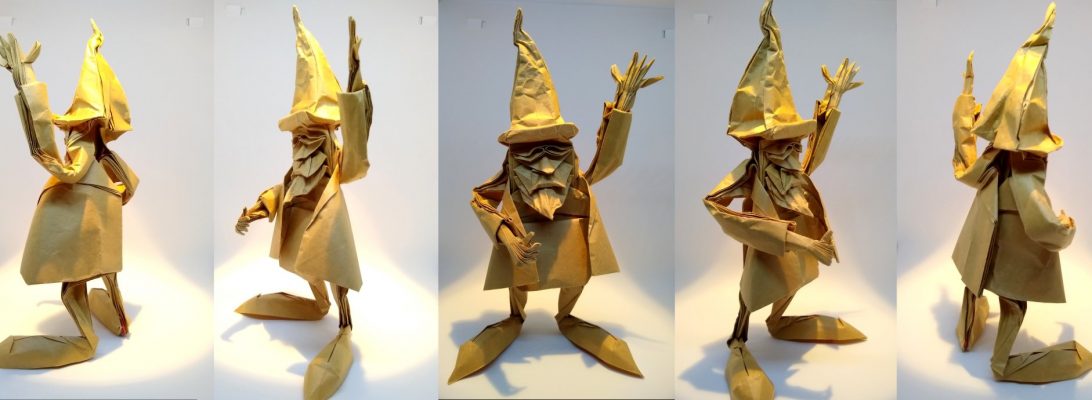
This is a wonderful character piece designed by Spanish origamist Fernando Gilgado. A hideous exercise in box pleating, made more so by the use of copy paper, which I struggled to prevent from disintegrating along commonly folded creases. After the initial pre-creasing, nearly no new folds are introduced in this brilliant design. He looks happy, a little silly, and has detailed face, a wonderful pointed hat with bells on. With duo paper, the face, hands and feet end up one colour, the rest (clothes and hat) are the other colour – again, genius in design.

I am very happy with this as a first fold – even if it seem to take an age it was a great way to weather a morning thunderstorm, and I will fold this again.

Because this model is flat, and great on one side (less so on the other), it suits card mounting, like this:

266: Master Yoda

Now I know I have, early on in this project, folded a figurative yoda but I thought it about time I did real justice to this loveable muppet (well, before he became pure CGI in the prequel abominations):

This lovely model is by Fumiaki Kawahata and is deliciously detailed.

I like that he has a 3 fingered hand, walking stick, lovely facial expression replete with crinkled brow and flowing robe. He also free-stands which is a bonus.

I am very pleased with this as a first fold – the diagramming was a bit of a mystery at many junctures so I found I had to improvise, but the model did not suffer for it I think.

The force is strong with this one, could do with a dose of the force actually to propel me over the 365 finish line, it has been a long haul so far.

Little Red – Revisited

Little Red was off to visit Kit:

Oh Jake, what big eyes you have, what big ears you have, what big teeth you have…

These are revisits of Stephen Weiss’ “Girl in a dress” and Kade Chan’s “Werewolf” for Kit and Jake.

Lunch with friends, nice. Lunch with friends and their kids, even nicer 🙂

258: Rodin’s Thinker

When I think of my mate Mike, I think of Rodin’s “The Thinker”:

There are many reasons, including his stunning good looks, poise but most of all because he is a thinker – he considers everything deeply, his responses are considered, balanced, always truthful and often factual 😛

This is a Neal Elias designed model, interesting use of an off-centre waterbomb base and trademark elias stretches to make the arms, I think it is particularly clever that the pose is fairly accurate, it is self-standing (well, ok, sitting), complete with all the body bits and perched on a pedistal to finish.

This is the second model I have folded from “Neal Elias – Selected Works 1964-1973” compiled by Dave Venables, purchased through the British Origami Society. As a founder in the box-pleating techniques that have been more popular in recent years, the shape is figurative yet evokes the object it was mimicking well I think.

I Think, therefore .. umm … what was the question?

256: Don’t Taze Me Bro

Akira Yoshizawa continues to surprise and delight – his folds are simple, elegant and have much modelling potential:

This is one of a series of person studies, and is a novel use of the frog base.

Busy day, lots to do, much being put off, you get that.

250: Child Protection Week

This week is designated “Child Protection Week” so I looked for a model that was for me the essence of the message:

Education is where I went – kids educated by older people is one of the best forms of protection around and this group of figures shows the careing and respectful relationship betwixt teacher and student to me.

I like how the elder teacher is balding (but in denial as he has comb-over side tusts of hair on an otherwise bald head), the student looks up hopeful from a book for guidance – just wonderful.

Folded based on a David Brill pair “Gippetto and Pinocchio”  from the aptly named “Brillian Origami” book, I like this grouping and hope you do to. The teacher is folded from a 2×1 and the student from a 2×1 that is 3/4 the size of the teacher. The book is a Brill book also (a spelling book, that only has 3 pages between a lovely bound cover), adding to the scene I think – the student’s hands looked empty without it.

Some lovely figurative folding, suggesting detail without folding every last nose-hair of it; the teacher’s head is a staggeringly complex box pleating trick and the student features a torturous collapse, but overall I can see the models are related, their bases were similar and the folding style of one compliments the other nicely I think.

240: The Stork Brings Babies

That’s right children, when the mummy and the daddy love each other very much, the stork visits them and brings them a baby:

Such a strange lie so often promulgated in years gone by to obviate an awkward conversation about the details of how birds and bees … well, you know … actually, that is even more confusing than the facts when you think about it – and what have birds and bees got to do with the process anyway?

This  is a simple and cute origami model to celebrate the many recent births (Dianne, Amanda, Brendan) – now the adventure really begins for these parents.

This is an old-school origami model that would probably be labelled “Kirigami” (a model that involves a cut sheet of paper) from Neal Elias – essentially it is 2 bird-bases grafted together via s split, allowing the 2 parts of the model to be folded carefully with each other.

Taken from Robert Harbin’s “Secrets of Origami”, a book in much need of repair nowadays as it’s binding is failing. Today’s folders would look to see if they could achieve this model from one sheet, with some clever box pleating to boot i suspect – interestingly no one has tried as of yet (well, that I can find at least).

New parentage – I remember those years with great fondness – that exhilarating (and daunting) moment when you realise that pink, wrinkled alien is relying on you totally for love and attention. Cherish the time you have with your kids – they grow up all too fast.

239: Little Red Riding Hood

Someone gave me a copy of foreign version of “Red Riding Hood” that I missed in the cinema that I thought was artistically interesting. A modern slant on a village terrorised by a werewolf, so I thought I would fold “Red”:

“Oh Grandma, what big eyes you have, ears, teeth …”, yeah, it was never going to end well. This model is designed by Stephen Weiss and reminds me a lot of the box pleating figure work of Neal Elias.

From a single A3-cut square we tease out a ruffled skirt, arms, head and feet and it results in a poseable model – very neat indeed. The instructions stop at the basic figure, so I added elbows, knees and tried to fashion feet (the thickness of the paper there made anything but “club feet” problematic – with thinner paper I think I could have fashioned shoes and socks for her.

When I first saw this model I thought that I would have to use tissue foil for it – indeed the recommended paper was much bigger and thinner but I decided to try and nurse copy paper through the fold and am delighted with the results. This would be a perfect little “dolly” for a well behaved little girl (Kit, are you listening? )