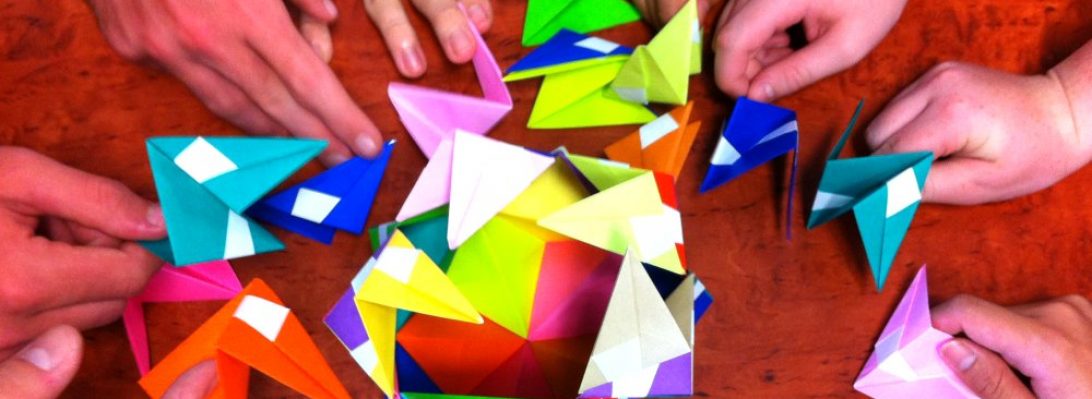
Sometimes a simple crease pattern leads to some interesting emergent geometry:
This is Charles Santee’s “Star Block”, a 2 part modular that I found when trolling among Origami USA’s “The Fold” issue #22. Continue reading
Sometimes a simple crease pattern leads to some interesting emergent geometry:
This is Charles Santee’s “Star Block”, a 2 part modular that I found when trolling among Origami USA’s “The Fold” issue #22. Continue reading
The internet is an amazing thing, it affords connections between mortals and luminaries in the field:
I noticed Sara Adams (a living legend in the Origami World) was asking for test folders to test diagrams she was drawing and I immediately put my hand up. Continue reading
Tomoko Fuse is a living legend in the Origami Community, her designs are numerous, intricate, ingenious and challenging to fold:
This is a 12 part modular with double-locks, frilly bits and framed holes in each face. Continue reading
Looking around for a chess board in origami was fun, there seem to be a few out there, including a few that use only 1 sheet of paper and a million creases to perform the necessary colour changes for the squares:
I discovered I could not source paper large enough to make a playable chess board, so looked for alternatives and stumbled across Joseph Wu’s modular chessboard. Continue reading
I am always on the lookout for a striking modular to fold when I am idle at work. This beauty – two tetrahedrons mating, was an obvious choice:
I have folded much more complicated versions of things like this – made with lots of little pieces each having different angle connectors. Ilan Garibi appropriates Francis Ow’s 60 degree unit and adds 2 different connector slots mid way along each long unit – a bottom edge slit and a top edge slit. These then mate seamlessly making it look like a pair of struts are in fact 4 bits of paper when they are not. The intersection of the 2 mating tetrahedrons is an octahedron; points rise from the octahedron faces making it stellated – genius. Continue reading
On the the pleasures (there are many) of visiting Japan at the moment is the onset of spring, and the flowering of cherry blossom trees:
I remember vividly the glorious show, in colours from deep red to white/lemon, trees around Kyoto and Miyajima being particularly lovely. Continue reading
I am such a fan of David Brill’s work:
His command of seemingly impossible geometry is complimented by the works of Francis Ow, the designer of the other “Double Cube” I have folded – a torturous skeletal structure. Continue reading
Trolling around on the internet, as one does, I came across instructions for a 3D cube Illusion by Nick Robinson:
I needed something that was relatively quick (times are busy, it was late) so thought I would give it a try. Continue reading
Sometimes a modular is deceptively complex, this 6-part modular from David Mitchell is no exception:
Four cubes, interwoven in evil ways has done my head in for days now, I simply could not (1) imagine the shape it was going to end up; and (2) make the modules connect in ways that made sense. Continue reading
I quite enjoy folding modulars – the way they combine to make a larger form can be fascinating and this module is no exception:
This is Dave Mitchell’s “Artefact” module, it can be put together in 2’s and 6’s. Continue reading
Toys for people with ADHD are all the rage – people pay for things with switches, moving clicky bits and spinney things because, reasons:
This paper toy continues to be an enigma. Made of 4 modules, it is a twisty cube that also folds flat in a myriad of ways that break your brain. Continue reading
We are heading into assignment season in many of my classes – this means my students are busy getting on with it, occasionally asking for help, but I am stuck there inert and when I get bored I get naughty:
…so I fold stuff to keep me awake. Modulars have an advantage that, once you have mastered the module, it is largely “rinse and repeat” until the final assembly. Continue reading
I must admit I like folding modulars – sure they take a little while but the concurrence of units to whole is a fascinating process:
This is David Mitchell’s “Omicron” – a fascinating block modular that, when folded with the right paper, looks solid and impossible. Continue reading
Starting with 2 squares of paper, some simple creasing, an odd thing happens – a solid shape emerges:
This squarish donut is odd, it slides together with nearly no folding and creates an interesting geometry. Continue reading