469: Fiddly Folding

My heuristic is that we do not get mail on Fridays – not sure it is always true but mostly. Last Friday I therefore did not check the mailbox. Sunday I discovered my Tanteidan had been delivered on Friday and I had left it for nearly 2 days before opening it.

On the cover, Gen Hagiwara’s violin – a sublime fold that I have seen many fellow paper-benders succeed at folding and I was determined to give it a bash.

Continue reading

468: I am Pegasus, My Name Means Horse

I am old enough to remember when a folk singer named Ross Ryan released a campy song about flying horses, and given that is an ear-worm of a song and it has just turned “Year of the Horse” for Chinese New Year, I thought it was an omen on what next to fold:

This is “Pegasus” by Dong Viet Thien from my newly arrived VOG2 origami book. A lovely use of a square, with some of the largest wings of this style of model I have seen.

Continue reading

467: Weave

Early morning catching up on Facebook, I saw a friend had posted a link to a Youtube clip of a woven ring:

I took 8 11cm squares (left-overs from the torus project) and split them into quarter strips (making a total of 32 strips of paper), then folded each strip in half longways then in half shortways – nice easy folding. Continue reading

Folding Algorithms – Sato Rose

Much of Origami is algorithmic (algorithm = procedural solution to a problem). A rabbit ear is an algorithm, one knows how to fold it on a corner – double rabbit ear is the same solution, folded two simultaneously. Petal fold is also a standard maneuver which got me thinking of the Sato Rose algorithm.

I like this algorithm particularly because of the free-form nature of much of the folding, and the way it seems to “fit” a pentagon. I decided to use the same folding algorithm but try it with other regular polygons – I tried triangle(3), square(4), pentagon(5), hexagon(6), heptagon(7), octagon(8), nonagon(9) but gave up on the decagon(10).

The algorithm involves “nearly” bisecting each vertex to form an echo shape at the centre of the sheet – you then halve that internal echo to create a slightly offset echo and use that as the basis of a “kawasaki twist” Continue reading

466: Hedwig the Wet-Fold Owl

Exploring my new VOG2 book, there are many lovely things to try but this model uses a method I have not been brave enough to try until now – wet folding.

The idea is to take heavy paper, too thick to fold conventionally (it would crack, split and otherwise be finger-bruisingly impossible to sculpt) and apply WATER to it before coaxing it into shape.

I used watercolour cartridge (27cm square) – a thick board-like paper that snaps when bent dry. Using a damp rag, I applied water to front and back and immediately the sheet transformed into this malleable leather-like slab. Continue reading

465: Green Dragon

Now I know you are thinking this is not green, but the design is named “Green Dragon” by Piotr Pluta:

After I made the double-sided double tissue I had been looking for a fold that would suit such a busy paper – it sort of looks like dragon skin/scales so the idea took. Continue reading

Green Tree Frog

I have recently spent time in a cabin in the woods – well, in truth, it is a cabin among some semi-tropical rain forest in the border ranges in northers New South Wales – a retreat for body and mind:

Having made some “double tissue“, I was itching to see how it took folds and I remembered a green thing I had folded way back as part of the 365 project – Robert Lang’s Green Tree Frog. My first attempt was small, white and not very detailed so I thought it might be fun to torture some double tissue with that design.

Continue reading

Double Tissue

Flushed with the success of MC on Ricepaper, I decided to try “Double Tissue” – a fine crisp strong medium that many origamists rave over.

I found some bargain animal-print tissue whilst looking on a whim in a “Crazy Clarks” wrapping section ($1.50 for 10 sheets 50x70cm), then went to the newsagent and purchased a packet of “Hallmark” brand tissue ($2 for 3 sheets 50x70cm) – both ends of the tissue paper spectrum I guessed. Continue reading

464: Say it with Flowers

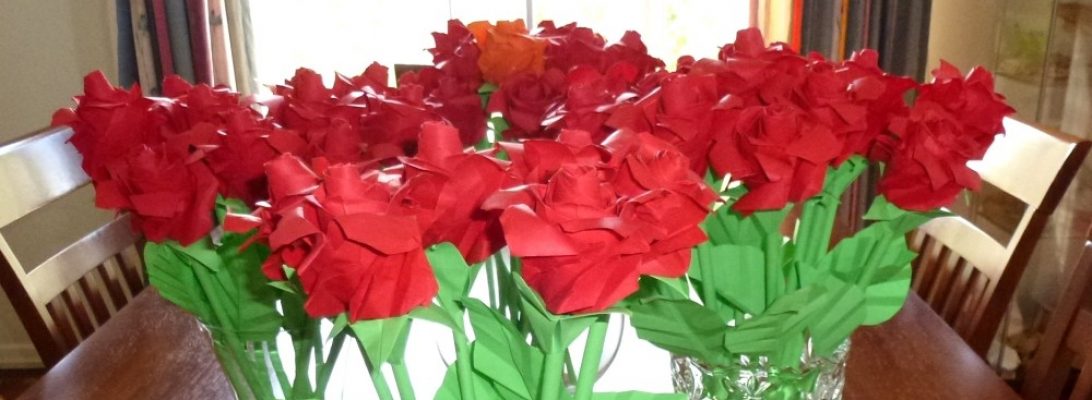
In our previous house I had a rose garden – I planted and maintained 42 rose bushes, lovingly collected cow poo, mulched, pruned and relentlessly sprayed them to combat the Queensland climate’s unsuitability for growing them. I also was a member of the Queensland Rose Society so occasionally displayed blooms at shows and in competitions, gaining an appreciation of the ‘technical appreciation’ of a bloom’s structure, symmetry and form. Needless to say I love roses.

I have long been fascinated and frustrated by the modified Kawasaki Rose II in equal parts, it’s mathematics is mind-buggering and all the techniques I had been exploring contained so much pre-creasing that the resultant bloom is mashed and dented beyond recognition. This variation, designed by Naomiki Sato is quite the loveliest thing of this ilk on the planet at the moment in my opinion. Continue reading

463: Going Crackers

Contemplating buying Christmas Crackers, you gain a sense of waste and expense – they are hideously expensive and full of stuff no sane person would actually want:

…so I thought about folding some.

I am fond of a twist, and whilst exploring the maths of a hex  twist, I discovered a method for making a pentagon-based twist with rolled seam and nice turnovers that seems to do the job admirably and also naturally results from a square. Continue reading

Cymbidium

I was gifted some beautiful but fragile rice paper (paper made with rice plant fibre) that is flecked with gold leaf:
Soft, fabric like I realised it was fairly useless as a folding medium so, armed with some freshly prepared MC, I plastered it to a window in the hope that the addition of sizing to the paper would make it useable. Continue reading

462: Samurai Helmet Beetle

Having ordered the book “Origami Masters Bugs – how the bug wars changed the art of origami” I was itching to fold a bug:

Robert Lang is a master paper engineer, I have a few of his books – this is from Origami Insects Volume II and I decided to give it a try – it was way outside my skill ability so I sort of resolved to keep folding until … I couldn’t work out what to do next, if that makes sense. In the end I managed all of the detailing (although some not very elegantly).

The resultant bug is astonishing – the legs are jointed and end in claspers, the head, cephalothorax jointed, it has antennae, horns and is really bug like. Continue reading

461: Lang’s Butterfly

Originally I was approached by a blog reader who wanted to know how a particular part of this model worked. Given I had never folded it before I had to admit I did not know, but would love to find out:

This is a torturous model by Robert Lang from his book “Insects and their Kin” – torturous because most of the detail originates in the MIDDLE of the sheet, via some astonishingly complicated manipulations. We tease 6 legs, abdomen, 2 antennae from the middle of the page, leaving large expanses of largely un-folded paper for the 2 pairs of wings.

I have wrestled with this for an age – not sure the instructions are very clear (particularly layer management late int he piece) and certainly are not noob friendly.

As a first fold I am very happy with the result – not sure I wold fold it again, I do not really like the way the body sits and the clumsy layering at the wing junctions but it was a fascinating exercise in accuracy none the less. I say clumsy but I know of the design genius to engineer such a shape, so please Mr Lang do not rake this as a criticism, I remain in awe of your paper prowess. Continue reading

460: Torus

Christmas is just around the corner, so I was thinking “wreath” shapes and stumbled across an astonishing torus made entirely of Tom Hull’s “Phizz” units:

The structure is based on twisted units that combine in 5’s (a pentagon has positive curvature), 6’s (a hexagon has zero curvature) and 7’s (a heptagon has negative curvature).

The inside has 10 heptagons and hexagon spacers, the outer rim has 10 pentagons with hexagon spacers and the rest of the shapes are hexagons.

This shape does my head in – heptagons take up more paper yet less space in the shape … huh? Negative curvature makes the inside of the donut by making a series of “saddles” which is pretty neat. Continue reading