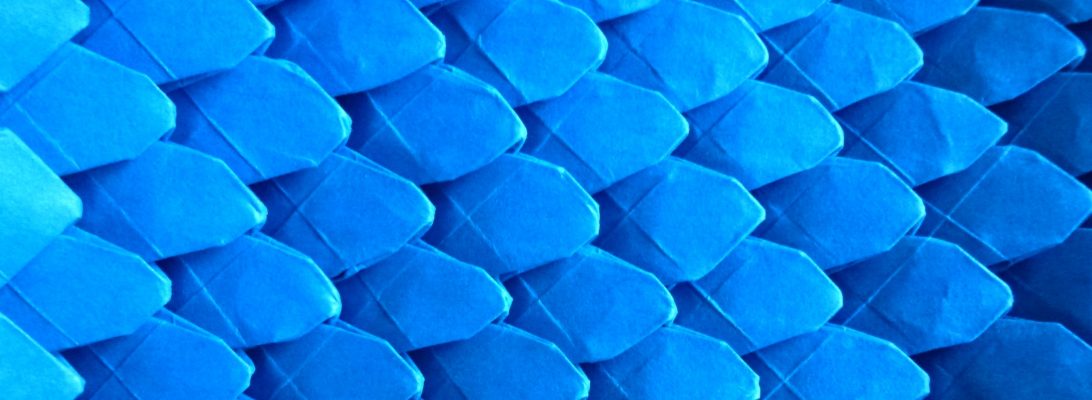
482: Four Interlocking Triangular Prisms

Procrastination, thy name is Wonko!

I had some time, and some coloured paper, so decided to try Daniel Kwan’s lovely geometrical modular:482FourIntersectingTriangularPrisms

Simple units, reminiscent of Frances Ow’s 60 degree unit interlock to form one, then two etc triangular prisms – choice of nice bold colours make this a real charmer. Continue reading

476: Shiny

In desperate need of some occupational therapy after a punishing term, I looked for a “no brainer” fold to calm my racing brain – instead I found this:

The CLO Kusudama, designed by Isa Klein was beautifully demonstrated in a video by Jo Nakashima, and I decided to give it a go. Continue reading

472: Decoration Cube

I came across a bunch of variations to a 12 unit modular cube that variously used a 1×1, 2×1 and 3×1 rectangle. I settled on the square variant (in retrospect I should have used the 2×1 version – half as much paper required, but you live and learn.

Initially I just was interested in the locking mechanism of a cube, so folded a red one. then I decided to see how a yellow one might intersect, then because I had some purple paper left over from the torus I thought to link the yellow to a purple, and the idea sort of grew from there.

I scoured my dealer’s (Rhonda, the custodian of paper supplies) shelves and ended up finding 11 different colours/tints – I added a “black” origami paper as the 12th colour and, hey presto they formed a ring of particular beauty.

It just sort of happened – I resolved to only fold during breaks at work, in front of kids, and over a period of 2 weeks it grew into a long chain and I was finally ready to join it into a ring.

I want to say this join was an easy, simple thing. I did not find it so – I tried, undid it, tried again, unfolded it (muttering obscenities under my breath). tried again, thought I had it until I realised it was wrong (the pattern should repeat, the join should not be visible – doh! Continue reading

467: Weave

Early morning catching up on Facebook, I saw a friend had posted a link to a Youtube clip of a woven ring:

I took 8 11cm squares (left-overs from the torus project) and split them into quarter strips (making a total of 32 strips of paper), then folded each strip in half longways then in half shortways – nice easy folding. Continue reading

459: Electra

Browsing an amazing book by David Mitchell called “Paper Crystals”, I spotted an interesting modular ball based on pentagons tiled with triangles named Electra.

Coupled with the original model was a suggestion that it was possible to make a 60 module version consisting of pentagons surrounded by squares separated by triangles. Continue reading

439: Nick Robinson’s Penrose Triangle

The “Penrose Triangle”, also known as a Penrose Tribar is an impossible object:

If you look at any vertice it makes sense but the shape, as a whole, cannot exist … well, until now that is.

When I first saw folds of this I was intrigued, knowing a folder on Facebook, he suggested I approach the designer, Nick Robinson, who graciously shared his design with me (isn’t the interweb amazing). Continue reading

433: Spikey Cuboctahedron

So I have this line I sometimes use: “find some nice paper and I will make something for you”:

A friend (*waves to Jan*) found a packet of 15cm (ish) hand-printed Washi and teh challenge was on.

Continue reading

431: Brill’s Woven Dodecahedron

As a teacher, I look for activities, particularly in the establishment phase of a year, to engage. Nothing says engagement like a hands-on physical activity and, as my wont is origami, I went for a modular project:

The themes for this were many, the metaphors a plenty – “many hands make light work” and “the sum is greater that it’s parts” being central.

Continue reading

401: Double-Star Flexi-Cube

It took me ages to even understand what this model was:

An ingenious design by David Brill, modular in construction composed of 3 different types of modules, clustered in threes, hinged together, it is a most perplexing construction.

A seemingly plain cube opens up to show a star, which fits wholly within the cube and is removable.

Flexing the cube makes another star, flexing the star makes a plank, stellated plain and other interesting twisted geometries.

This is a keeper – paper tension keeps it in shape generally but it does not strongly lock, so I may resort to cello-tape on the joints so it can be handled without risk of it disintegrating (as it did to me twice).

The geometry is interesting, photographing it seems not to do justice to the shapes but I am glad I finally nutted it out – bravo Mr Brill.

393: Six Intersecting Pentagonal Stars (SIP)

When I first saw this thing on Happy Folding I knew I was destined to try it:

This glorious modular designed by Francesco Mancini uses a unit similar to a Frances Ow 60 degree unit but in a very different way to make chevron-shaped modules that lock together to form pentagonal stars.

The tricksey part is to then nestle the stars so they are inside each other, weaving one inside and outside every other star – thank goodness I chose a different colour for each star else I have no idea how I would have managed to work out what strut went where in the construction.

I am quite chuffed (and a little relieved to be honest) with the result as I attempted to construct it 7 times before successfully working out what went where. Fully formed it is quite stable and rigid – it was everything but that during construction however making it very awkward indeed.

Lovely stellar structure suitable for display.

389: Kusudama Dafina

I saw Tadashi Mori demonstrating a Kawasaki Rose-based modular and thought I would give it a whirl:

Having failed miserably every other attempt to fold a Kawasaki Rose, I was chuffed to succeed this time.

I want to say I will fold this again – it took an age and although I was impressed with the rose, the modular attachments (tabs and pockets) did not positively hold it together (I cheated in the end and stapled them together).

Each rose is a masterpiece of box pleating prep work followed by a beautiful spiral collapse. Happy to be finished it tho.

386: Dimple Ball

Looking for a neat, colourful use for a batch of poor quality origami paper I had, I stumbled across a modular dimpled sphere:

The paper cracked and spilt in ugly ways, so I had a good wrestle to actually construct this. Interestingly, when complete it became quite rigid and strong but prior to the last few modules were wrangled into place, it was floppy and kept unfolding inconveniently.

The result is spherical, with lovely pentagonal dimples, with modules centred in fives, meeting in threes – lovely application of maths.

I must look for modules that differ in the basic 32 module sphere, and also for one whose modules are more positively connected. This one is, however, randomly beautiful.

You can have a try of this yourself – go here for instructions

383: Slinky

Now I am a fan of a simple but effective modular, and this one is a lot of fun:

Modelled after a spring-slinky, designed with skill by Jo Nakashima, it stretches, falls and steps like the real thing.

Using remarkably simple modules, each from a small square, the structure begins to behave when there is sufficient mass in it to be propelled by its own momentum.

I like this model a lot – it was a fun way to while away an exam supervision and the construction method was simple. I ended up making over 50 modules before it started behaving correctly but even this feat did not take very long.

Give it a try, you know you want to…

379: Dodecahedron

In search of a new modular to adorn my computer lab, I stubbled across a dodecahedron that looked interesting enough:

Thirty modules later, I began to attempt to construct – after 7 different attempts and modifications I could not find a way to make the modules lock together convincingly.

Defeated, I resorted to a few well-placed pieces of sticky tape (on the inside) to keep the pentagonal faces together. Overall it is a pleasing construction (all be it a little cheaty)

I shall continue to look for modulars – there are lots of varying complexity – the geometry alone is reason to attempt them. This module constructs a 73ish degree angle which is a little big for a pentagon, causing a paper tension that naturally tries to spread the joints.

355: Robin Star

I was trolling fakebook and came across a lovely video posted by noted origamist Jo Nakashima:

Designed by Maria Sinayskaya, this simple but beautiful wreath modular is a keeper – make it out of coloured wrapping paper, small, and it is a lovely tree decoration.

I like this a lot – a good solution to a “what the flooping heck am I going to fold today” situation. Folded in 8 parts, you should have a go at this.

Nearing the end – 10 more to go until this challenge ends – wooo!

Want this? BID for it NOW.