470: Osteichthyes

Osteichthyes or BONY fish appear from fossil evidence as far back as 420 million years ago when they appear to have differentiated from cartilaginous fishy things. Fossil records are sketchy but shapes and morphologies are visible in traces in very ancient rocks.

This odd origami attempts to hint at the faint fossil traces left in a rock of a conventional bony fish and it does a pretty good job for such a simple fold. Continue reading

468: I am Pegasus, My Name Means Horse

I am old enough to remember when a folk singer named Ross Ryan released a campy song about flying horses, and given that is an ear-worm of a song and it has just turned “Year of the Horse” for Chinese New Year, I thought it was an omen on what next to fold:

This is “Pegasus” by Dong Viet Thien from my newly arrived VOG2 origami book. A lovely use of a square, with some of the largest wings of this style of model I have seen.

Continue reading

466: Hedwig the Wet-Fold Owl

Exploring my new VOG2 book, there are many lovely things to try but this model uses a method I have not been brave enough to try until now – wet folding.

The idea is to take heavy paper, too thick to fold conventionally (it would crack, split and otherwise be finger-bruisingly impossible to sculpt) and apply WATER to it before coaxing it into shape.

I used watercolour cartridge (27cm square) – a thick board-like paper that snaps when bent dry. Using a damp rag, I applied water to front and back and immediately the sheet transformed into this malleable leather-like slab. Continue reading

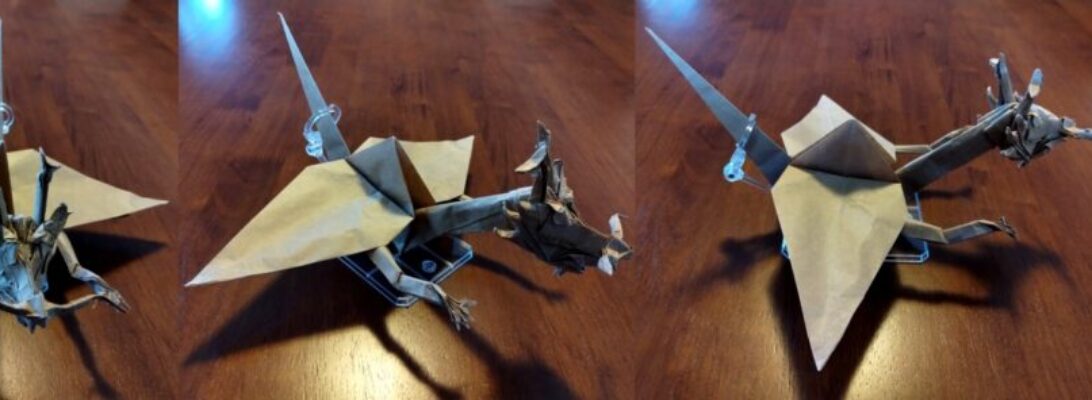
465: Green Dragon

Now I know you are thinking this is not green, but the design is named “Green Dragon” by Piotr Pluta:

After I made the double-sided double tissue I had been looking for a fold that would suit such a busy paper – it sort of looks like dragon skin/scales so the idea took. Continue reading

Green Tree Frog

I have recently spent time in a cabin in the woods – well, in truth, it is a cabin among some semi-tropical rain forest in the border ranges in northers New South Wales – a retreat for body and mind:

Having made some “double tissue“, I was itching to see how it took folds and I remembered a green thing I had folded way back as part of the 365 project – Robert Lang’s Green Tree Frog. My first attempt was small, white and not very detailed so I thought it might be fun to torture some double tissue with that design.

Continue reading

462: Samurai Helmet Beetle

Having ordered the book “Origami Masters Bugs – how the bug wars changed the art of origami” I was itching to fold a bug:

Robert Lang is a master paper engineer, I have a few of his books – this is from Origami Insects Volume II and I decided to give it a try – it was way outside my skill ability so I sort of resolved to keep folding until … I couldn’t work out what to do next, if that makes sense. In the end I managed all of the detailing (although some not very elegantly).

The resultant bug is astonishing – the legs are jointed and end in claspers, the head, cephalothorax jointed, it has antennae, horns and is really bug like. Continue reading

461: Lang’s Butterfly

Originally I was approached by a blog reader who wanted to know how a particular part of this model worked. Given I had never folded it before I had to admit I did not know, but would love to find out:

This is a torturous model by Robert Lang from his book “Insects and their Kin” – torturous because most of the detail originates in the MIDDLE of the sheet, via some astonishingly complicated manipulations. We tease 6 legs, abdomen, 2 antennae from the middle of the page, leaving large expanses of largely un-folded paper for the 2 pairs of wings.

I have wrestled with this for an age – not sure the instructions are very clear (particularly layer management late int he piece) and certainly are not noob friendly.

As a first fold I am very happy with the result – not sure I wold fold it again, I do not really like the way the body sits and the clumsy layering at the wing junctions but it was a fascinating exercise in accuracy none the less. I say clumsy but I know of the design genius to engineer such a shape, so please Mr Lang do not rake this as a criticism, I remain in awe of your paper prowess. Continue reading

Hideo Komatsu’s Owl

You find wisdom and counsel is the most unexpected of places, people can be wise beyond their years and offer you more support and encourage than they realise.

I was asked to fold an owl, simultaneously, for two completely different purposes. (1) A good mate wanted to give an Owl to someone who had helped him out with some well chosen words of wisdom. (2) During the World Origami Days event organised by MiniNeo, I was challenged to fold an Owl by Sebastien Limet. Continue reading

“You Shall Pass!”

Sometimes we all need a little magic in our lives:

If anyone can get us past the Balrog and on beyond Mount Doom, Gandalf can.

Made from a square (and the scrap cut off to make it a square to make the staff) for a friend who, like all of us, is a valuable and important part of this world.

Smee

The link between a boy and his pet is a special one, even if the pet is a hermit crab named “Smee”

When I heard Sam had suffered the loss of Smee I remembered the pets I had also said goodbye to, tough gig indeed.

I remembered I had folded, as part of the 365 project, a hermit crab – never quite mastering the fold so was determined to re-attempt it (with a few more years skill under my belt) Continue reading

456: L’essence d’un escargot

I was exploring a corrugation technique I last used with Eric Joisel’s Bandoneon and stumbled across a sort of plan to fold Joisel’s Snail:

You start with an extraordinarily long (my estimate – 3.25m) and narrow (in my model 9cm) strip of paper, then start folding slanted lines (using a 3:1 gradient) in both directions

Continue reading

The Whole is Greater than the Sum of Parts

You may remember I recently folded a Chuka Ryu, and it had a particular spiral bend to it…

… that spiral corresponds to the diameter of the white keep precisely – one sits inside the other.

This now tells a totally different story – what is happening here?

Add your narrative suggestions to the comments section.

454: Unryushi Darkness Dragon 2

I was given a beautiful sheet of Unryushi tissue by a friend. The arrangement (in case YOU want to take part also) is if you give me nice paper, I will make you something out of it.

I prepared the paper by Methyl Cellulosing it to a clean window:

This make it crisp and strong, then, in a dragony frame of mind, I used Tadashi Mori’s own folding tutorial to fold a Darkness Dragon 2.

I had already folded the Darkness Dragon 1, but this model was a refinement I had not tried. There is a killer collapse after some exacting pre-folding – a sort of all these folds happen at the same time whilst inside a bunch of others, but the sense of it makes for a lovely body.

Continue reading

453: The Age Of Aquarius

When the moon is in the Seventh House
And Jupiter aligns with Mars
Then peace will guide the planets
And love will steer the stars

This is the dawning of the Age of Aquarius
Age of Aquarius
Aquarius! Aquarius!


I saw a crease pattern whilst trolling through the Origami Forum that looked like it was relatively straight forward to lay out on a piece of paper, based on fairly well controlled 64th grid with some fairly straightforward easy to locate landmarks and so thought I would give it a go.

It took nearly 2 days to lay all the creases in to the crease pattern – wiggly lines in one corner were punishing and at the time I had no idea what were to be mountain and valley folds so just made sure they were good creases reasoning they would reverse effortlessly.

Continue reading

451: Tarsier

I had a small but lovely piece of elephant-dung paper – now this is not as gross as it first sounds, the paper is cleaned fiber retrieved from elephant dung – yeah, ok, it does not sound any less grotty – lovely textured irregular and lumpy paper though it was:

I needed a model, Sebastien Limet’s Tarsier seemed most logical (given I had not folded it before and I thought folding it near life-size might be an interesting challenge).

There is much to love about this model – apart from the delicious expressiveness of the face, delicate grip of its primate hands or the prehensile grip of its tail, this is a real charmer.

I like that the face is implied, but I can see lovely big innocent eyes, sensitive ears and all the hallmarks of a delicate but mischievous “bush baby” which makes these little chaps endangered in the wild because rich folk sentence them to long agonizing deaths as pets outside of their native habitats. Continue reading