Hana Midoh (Sweet Shower House for Celebration Buddha Just Born)

Ages ago, using up the white papers from a cheapo pack of coloured 15cm square origami papers, I first had a go at folding an origami “Spirit House”:

Designed by Ichiro Kinoshita, this model emerged from my “to fold” pile and it was meant to be.

I had not long returned from a trip to Japan (in the late nineties), and fell in love with the idea of having a Spirit House at our front door. Apparently it is a tradition to provide a home for good spirits – they then repel bad spirits. We have had our “spirit house” for decades, I love it.

I decided it was time to fold a better version of the rough first go, so turned to my stash of hand-made Kozo and cotton paper I had made from pulp back in October 2024 – it has a “stone-like” appearance so I thought it would be perfect.

I cut 3 18x18cm squares and a 20cm square, then set about folding the parts (it is sort of a modular, 2 parts of which need to be glued together). The paper is fairly thick and fabric-like, but takes folds fairly well. I used some strategic glue spots to keep seams closed, wrestled a little with the thickness but was happy with the results in the end.

Continue reading

Null and Void

I decided I needed to do a presentation fold of Boice Wong’s wonderful pair of models he calls “Head Empty”.

My previous folds were with plain Kraft paper, but I decided I wanted to show off the clever colour changes implicit in the design, so re-folded them with White/Natural Kraft paper over the last week or so.

Having released only Crease Patterns (CP), part of the delicious challenge of this pair of models is working out what becomes what. Although related, the 2 models use CP variations that both allow for the formation of a box head, one attached to shoulders, the other not.

Continue reading

1174: Iterative Design

One of many design techniques used in Origami (and other aspects of life) is Iteration.

I decided I wanted to make an Origami approximation of a Mitsubishi Triton with a “camper trailer” modification.

I did some rifling through my Origami reference collection and found in the OUSE Convention book a lovely base “Jeep” model, designed by Stefan Delecat.

Folding it gave me some useful widgets for isolating tyres, windscreens and integrating them into a car body … but … it was the wrong shape. On the folded maquette I penned areas that needed expanding and contracting. Unfolding that maquette I was able to see where “grafts” were necessary. A GRAFT is the addition of extra paper to enable a feature – it ahs knock-on effects however of requiring you to deal with the extra paper in areas it was not originally in.

Folding the first iteration of solution, I added waaay too much paper, ended up with a stretched limo, but that sparked the “I can cold the whole thing, including tent with one sheet” fiasco – refolding it again and again I abandoned that idea because it ruined the line of the vehicle – technically possible yes, aesthetically pleasing solution no. Re-working the grafts allowed me to add width and length grafts that I folded into a final proportioned maquette.

Fortunately, the width and length grafts allowed me to add “seams” between the Cab and the trailer. adjust the height of the trailer section and correct the proportions of hood-windscreen-cab that align the model more closely to the actual vehicle.

Continue reading

1153: Tanteidan “Cubes”

At any moment, I have a half-dozen Tanteidan magazines, from my subscription to the Japanese Origami Society, on my chair-side table yet to be filed:

Flicking through them, it is impossible not to be intrigued by the challenges, fold tidbits, crease patterns and full diagram sequences.

Sadly, I contrast it to British Origami Society Magazine – I used to subscribe but let that membership lapse when I got to the situation that I folded nothing from them for 4 issues in a row.

These models are modular “cubes” designed by Jun Maekawa – delicious geometric puzzles with radically different design methodologies. The “Cat Ear” cube is a 6-module cube that is related to the “Business Card” cube I have made into a huge Menger sponge.

Paper friction and tabs and pockets offer structural strength, properly interleaving the tabs make it a really stable piece of geometry.

The “Zig Zag” cube is different – it uses 2 pieces of paper total – each “half” of the cube is folded complete (internal and external surfaces) from a sheet of Duo paper. Ingenious in design, fiendish the first time you try to link the 2 halves, delightful together and apart.

I love these little gadgets – every Tanteidan has at least 2, I have barely scratched the surface of them.

1131: The Work of Fynn Jackson

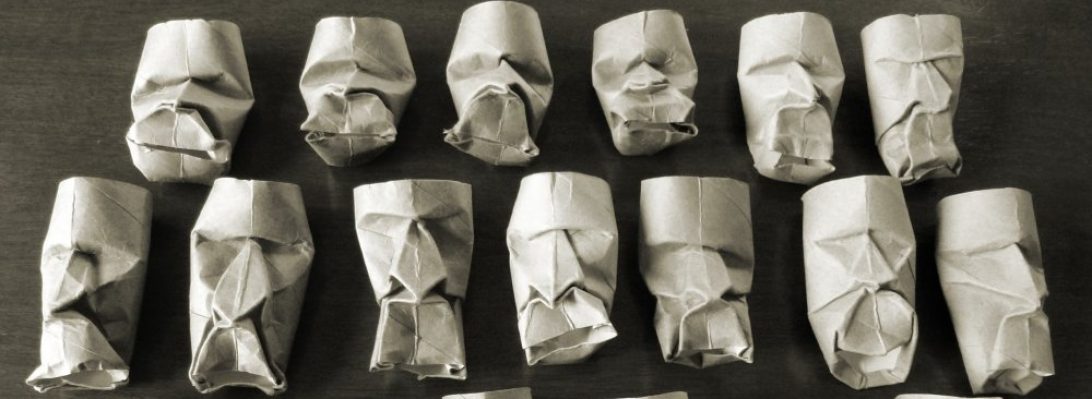
A long while ago, a new artist on the scene, Fynn Jackson, started releasing astonishing mask crease patterns on social media.

He later commercially released his designs and I purchased his crease pattern packs for masks 1-35, along with the more recently released noses 1-9.

I love Fynn’s work, and eventually will develop my own CPs of faces. There is so much expression in the score and fold bundle, so decided to expand my collection and try out a bundle of manilla card in the process. I contacted @Jacksonorigami and asked him about selling finished masks – he (to my surprise and delight) freely encourages folders to monetise their rendering of his designs, so long as we do not share the purchased CPs (so please DO NOT ASK) …. so I got to thinking about an upcoming Gallery shoppe associated with my papermaker friends PAQ – put 1 and 1 together and arrived at 6.

I set about folding 6 faces I had not tried before from Fynn’s rich collection of characters, each using different aspect ratios, techniques and all quite wonderful. I was encouraged (by some of the wonderful ladies in PAQ – I am looking at you Ann and Wendy!) to consider selling, and began thinking about displays that would make them work as purchaseables.

Continue reading

1124: Vase Algorithm

I recently opted in to a “fold along” workshop (at 1am-3am local time) with Gerardo at neorigami.com and a number of guest demonstrators. The first model was a square “Vase” designed by Saburo Kase:

The process, starting with a “preliminary base” got me thinking about generalization of the algorithm to other regular polygons. The corner treatment is radially symmetrical (ie. you do the same thing on each corner), and has 3 “about here” judgement folds that all combine to control the final shape of the vessel …. so….

I cut an equilateral triangle, a new square and a regular hexagon, then formed “preliminary bases” from each geometry.

Next, I followed the corner algorithm on each of the 3, 4 and 6 corners respectively to see how it behaved. I now regret not also using a regular pentagon, as I think it would possibly be a “sweet spot” for the organic shaping … maybe some other time.

Continue reading

Exhibition

Our local community Library has display cases, I have more origami models in storage that I can count any more so offered to provide some models for a month or so for a display:

Display cases

The interesting part of this was selecting a variety of models to demonstrate the breadth of the discipline. The challenge was to select only enough models to fill the small display cases.

Case 1

I decided on a varied collection of single sheet figures, modulars and old favourites, the mix is eclectic and dizzying.

Case 2

The exhibit is on display at least until the end of August, possibly longer.

You can go see it at Holland Park Library

988: Ramen

Sometimes, just sometimes, it has to be noodles – rice or wheat, in broth, that are schlurped while way too hot, because … reasons:

Ramen bowl

I saw a crease pattern (CP) by Jinjang on an origami Discord I frequent and (in the season of justifiable procrastination) had to fold it.

Ramen CP

I think there are errors on the CP, as I found I needed to adjust crease lines to properly form the bowl, and would probably manage the colour of the lip differently next time, but as a first fold this was a really interesting exercise.

Continue reading

Showing Off

Our school has large display cases. I have kilograms of origami at home, in showboxes, tidy tubs, cupboards, garbage bags and display cases … one thing led to another:

library display 2019

My aim with this display to to show the variety of forms modern Origami takes, from traditional, figurative, geometry and abstract. Additionally I have included 14 different dragons, a current fascination – can you find them all?

I feature some of my favourite pieces, designed by legends such as Satoshi Kamiya, Robert Lang, Eric Domaine, Francis Ow, Ronald Koh, Kade Chan, Eric Joisel, Brian Chan, Jason Ku and more.

Continue reading

955: Versailles Box

Looking for a rose-based box for a gift, I came across Tadashi Mori’s tutorial for this fold:

Versailles box

Made of “curler” units, the rose-like structure on top of the box required 4 squares. The box lid also requires 4 squares, the base also – 12 squares all up.

Continue reading

948: “Snow Crystal” Hex-box

I have been looking for tidy self-contained folds based on A4 paper that hides the raw edges, so I could try my lovely thistle-based hand-made paper (from the ladies at Paper Makers and Artists):

snow flake box complete

This box looks like a traditional fold, but seems to be credited fairly recently to Sweet Paper, a paper art shop/tutorial site I stumbled across in my musings. Not sure of the attribution however, as many of their featured designs I have seen (and folded) from other artists.

lid and base. Lid is 3/7ths of the sheet, base is the rest

The paper, with lovely rough chopped scotch thistle fibres and other pulp is fairly crisp, fairly thin but had raggedy (beautiful) decal edges that I did not really want to have to chop off.

Continue reading

916: Zhen Xian Bao (Traditional Chinese Thread and Needle Book)

Interestingly, paper folding developed independently in most countries that made paper. In China, traditional folding included objects like this:

This is a modern interpretation of a Zhen Xian Bao – a traditional thread case. Even cursory research on teh interwebs reveals astonishing combinations of these little compartments, nested in other compartments.

This fold was designed by Paula Versnick, and has 7 separate compartments of varying size, that all lock together into a charming little book. Continue reading

910: (360/365) After Christmas Sales

Retailers really have a nerve when you think about it. Right up to Christmas they hike up their prices. We dutiful drones pay top dollar for loot which we wrap and give away. Come “Boxing Day” prices plummet in almost obscene ways and it can get hectic as people clamber for bargains:

We went early, with a list and an idea of what we would regularly pay for the items on that list. In, bought (from the then still full shelves and racks), and out again in an hour and a half – this is the stuff of legends. Continue reading

909: (359/365) The Real Present is your Presence

Christmas is many things to many people. For me it is another chance to get together with family and catch up over a shared feast:

I hope that wherever you find yourself, you stay safe and look after each other, share some joy, love, hugs and laughter. Merry Christmas, ho ho ho and all that humbug. Continue reading

891: (341/365) Drop Box

Apparently there is a lolly in Holland called “Drop” – it is most likely a salted licorice, must look that up. This box is designed to gift “drop” to friends:

When I first saw the model I was sure it was a bomb … I mean, look at it! Continue reading