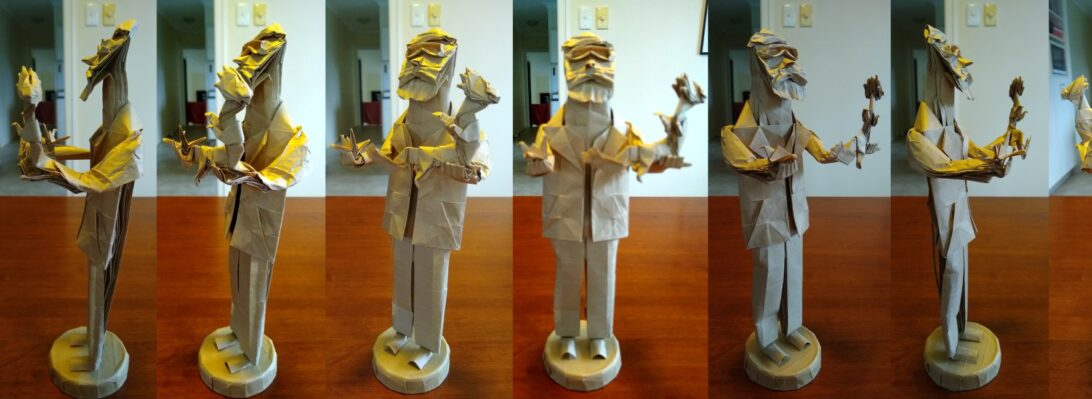
I recently was on holiday in regional Victoria, and have a few models as “catch-up”:
Our holiday digs were near a lake, rich in bird life. Continue reading
I recently was on holiday in regional Victoria, and have a few models as “catch-up”:
Our holiday digs were near a lake, rich in bird life. Continue reading
Sometimes tending the nest is more important than what is happening elsewhere:
This is Edwardo Clemente’s “Mother Bird” (I think that is what it is called, it is all in Spanish) and is a charming little bi-colour model that manages to tease a lovely flappy mother twitter bird, a pair of hungry chicks and a colour contrasted nest from a single sheet. Continue reading
When planning origami models that will be good for permanent display, locks and paper tension matter as a model will try to unfold itself:
This genius design results in a fairly faithful swallow, the body is rounded, beak and head cleverly proportioned, tings and tail streamlined – it looks like it would fly. Continue reading
Those of you familiar with a traditional crane (Tsuru) will notice this one is a little odd – that is because it is folded on top of/inside a flapping bird:
This is an ingenious and complicated fold, for bi-colour paper that cleverly interweaves one model in the other. In the 3D photo below you can see the flapping action more completely – this model moves!
I realised I had never folded a traditional flapping bird, so this was a bit of a revelation – such a simple action model indeed. Continue reading
The Chinese Zodiac is rich with myth and legend, most cultures are full to the brim with such fancy. Chinese New year is based around the Lunar cycles, as such seem oddly placed to us westerners:
Moon cakes, yum cha, char sui hanging in a chinese butcher’s window, the red of firecrackers, the noise and smoke of a dragon dance – all wonderful to be part of. Most cities have a “China town”, in Brisbane it is a section of Fortitude Valley – these areas come alive at this time of year … mmmm, need some dim sum and a nice pot of jasmine tea. Continue reading
Chinese New Year seems more complicated then celebrating the end of a calendar year, my research suggests that today is Chinese New Years Eve:
This year the symbol is a Rooster, well more correctly a fire rooster, and this is the first in a series of folds designed by Mi Wu that perfectly capture the mood of a proud cock. Continue reading
Those who know me realise I am a little obsessed with paper folding, some would say to excess. The truth of the matter is I am constantly amazed what you can coax a flat sheet to do. I think I missed my calling as a materials engineer:
I like models that I can visualise, as I am folding. Equally, I am fascinating when there is a tangle and then, out of the mess, something wonderful emerges. Continue reading
Returning to work, we balance between the stinking hot outside temperature and the painfully cold airconditioning (yes, I know this sounds like a first world problem, and it is), but I decided to fold a critter that has evolved to put up with intolerable temperatures:
This is Jo Nakashima’s Penguin, a lovely little model with a blocky, cartoony feel to it. Continue reading
I try to mark the passing of Hiroshima Day August 6 with respect and effort.
Having folded the traditional 1000 cranes twice in my life (oddly, the second time my cranes were “borrowed” by a then campaigning year 11 for a community project where he received the credit and was subsequently elected School Captain … but I digress) so thought it time to try something new. Continue reading
Continuing my exploration of Hiden Senbazuru Orikata (The Secret of One Thousand Cranes Origami), published in 1797 I managed to wrangle a triple Tsuru:
The original schematic suggests that you use 2 small squares attached to the wings of the larger square, and I cannot fathom whether the dotted lines mean “remove” the unused paper or “hide” it. I chose to hide it.
We end up with parent and 2 kids, joined at the wings. The actual folding is fairly fiddly and the paper hiding makes the head/tail of the parent very thick (or was it the paper I chose?) Continue reading
Taking a square and (nearly) cleaving it into 4 separate sheets leads to an interesting design dilemma:
When the join is in the centre of the sheet, you can join wings, tails or I suppose beaks together.
When the joins are at the edges of the sheet, you could join wings, beaks or tails but I went for the symmetry of wings in this fold. Continue reading
Joined at the wing, this pair of Tsuru (traditional Cranes) was folded from a single sheet split nearly in half:
Taken from “Hiden Senbazuru Orikata (The Secret of One Thousand Cranes Origami)” published in 1797. It is part of a series I hope to tackle…
The trick is to not tear it as you fold it – the paper tension at the split is tenuous, so requires a gently, deft touch. Continue reading
Browsing the internet, as you do, I came upon a chance find of an amazing archive of pages from what is thought to be the oldest Origami book published – “Hiden Senbazuru Orikata (The Secret of One Thousand Cranes Origami)”, first published in 1797:
Looks like i have a new project, making Tsuru (traditional Cranes) in multiples on a single (cut) sheet – looks like it is going to be a fascinating ride.
I am on constant awe of folders from the Vietnamese Origami Group (VOG):
Hoang Trung Thanh’s Eagle 3.5 is an astonishing and dense fold that really tests patience, accuracy and paper but the result, even this partially incomplete rendition is lovely. Continue reading
I was asked if I could make a flock of birds designed to be attached to fishing line on the end of poles that seem to fly:
I remember a “seagull” by Toyoaki Kawai, in an old book I had so based a fold around that basic form. Continue reading